

 由 Sherry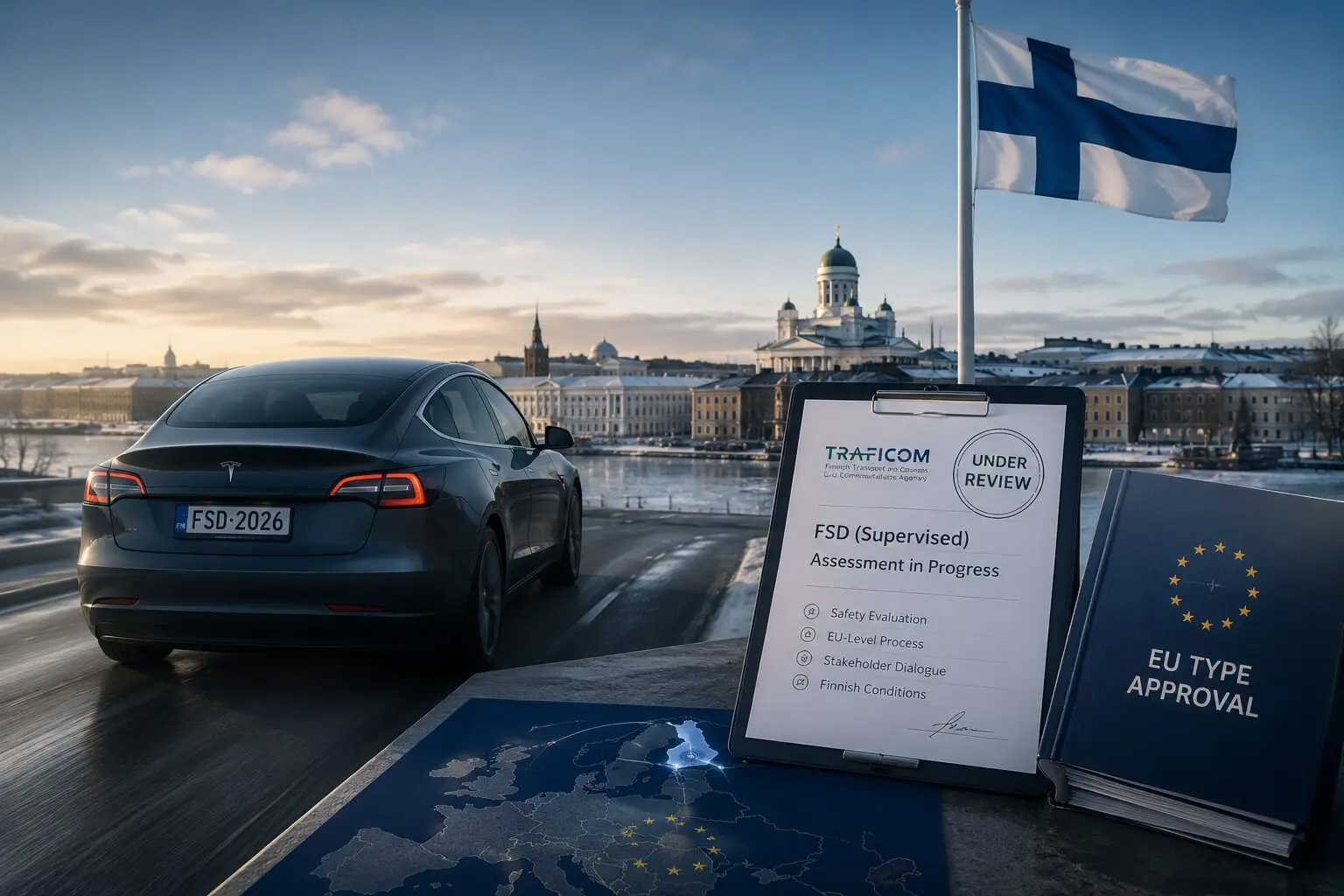
Table of Contents
Why Finland matters
Finland is not one of Europe’s largest auto markets, which is part of why the reported review is worth watching. If a smaller but serious regulator is willing to look at Tesla’s supervised driver-assistance system before a wider EU decision, it could show how Europe handles software-defined cars in practice.
Several Tesla-focused X posts pointed to Finland’s Transport and Communications Agency, Traficom, as it reportedly evaluates whether Tesla FSD could be approved in Finland before an EU-wide process expected later in 2026. The interesting part is not the fan reaction. It is the question underneath it: what evidence should count, who should make the call, and how should regulators treat a system that changes through software updates?
Europe has been cautious with advanced driver assistance, and there are good reasons for that. Roads are public spaces. Regulators cannot grade a system on ambition or branding. But caution can also become a bottleneck if the rules assume a product is fixed while the system being reviewed keeps changing.
FSD does not need to be perfect to be judged
The weakest version of the FSD debate asks whether the system is perfect. It is not. Tesla describes FSD as supervised, and the driver remains responsible. A more useful question is whether supervised automation can reduce some types of human error when used correctly, and whether regulators can measure that without ignoring the failure modes.
That matters because human drivers are not the baseline of perfection. They get distracted, speed, miss intersections, drive impaired, and react too late. A supervised system does not need to be magic to be useful. It needs to be safer or more consistent in defined conditions, and it needs to make its limits clear enough that drivers do not misuse it.
The reported Finnish approach appears to leave room for both sides of the issue: possible safety benefits from reducing human-factor crashes, and the need for a careful approval process involving Tesla and other stakeholders. That is a better posture than either blind enthusiasm or automatic rejection.
Europe’s approval model was built for slower products
Europe’s vehicle rules grew out of type approval. A vehicle or system is examined, documented, certified, and then sold. Software-defined cars make that harder. A Tesla feature can change through over-the-air updates. A neural-network behavior can improve after new data is added. The same name, including FSD, can describe a moving product rather than a fixed part.
That leaves regulators with a real dilemma. If they approve only a frozen version, they may slow down safety improvements. If they approve a broad capability without tight oversight, they may give too much discretion to the manufacturer. The workable answer is probably conditional approval, reporting duties, incident monitoring, clear operating limits, and the power to require changes if the evidence turns negative.
That is why the Finnish case could matter beyond Tesla. Chinese EV makers, European automakers, and software suppliers are all pushing toward more advanced assistance systems. A process created for Tesla now could become a model for other connected vehicles later.
What approval in Finland would mean
If Finland approves Tesla FSD before a broader EU decision, it would not mean Europe has declared the system autonomous. It would more likely mean a national regulator found a legal path for a supervised feature under specific conditions.
That distinction needs to be clear. Approved does not mean driverless. It means the system met a deployment threshold. Drivers would still need to supervise, follow local laws, and be ready to intervene. Tesla would still need to manage performance, explain limitations, and respond to regulators.
For Tesla, even limited approval would matter. It would give the company a European foothold, produce data from local roads, and put pressure on other regulators to explain their own standards. For competitors, it would raise the bar. If Tesla can show one European regulator that its system can be reviewed, other automakers will need evidence for their own systems too.
Public trust may be the harder test
The technical review may be easier than the public one. FSD is already heavily politicized. Some people treat it as inevitable. Others treat every Tesla safety story as proof that advanced assistance should be slowed down. Regulators have to work in the middle, where the details matter.
That means explaining the reasoning where possible, separating supervised assistance from robotaxi autonomy, and spelling out what data is being considered. It also means not judging FSD only through viral clips. Videos can expose edge cases, but they are not a replacement for systematic safety analysis.
Finland’s possible role is bigger than one market launch. It could show whether Europe can regulate advanced vehicle software seriously, without fear doing all the work. The goal should be to protect road users while still allowing software improvements to reach the road when the evidence supports them.
The best outcome would not be a quick yes or no. It would be a repeatable process: here is the evidence, here are the limits, here is how updates will be monitored, and here is what happens if the system misses the mark. That kind of framework would matter long after the current Tesla debate moves on.
Source
- Sawyer Merritt X post on Finland and Tesla FSD: https://x.com/SawyerMerritt/status/2069423224585134112
- Kees Roelandschap X post on Article 39 and Tesla FSD: https://x.com/KRoelandschap/status/2069411552940228858
- Ming X post on Traficom evaluating Tesla FSD: https://x.com/tslaming/status/2069402835763257797
- Tesla Autopilot support page: https://www.tesla.com/support/autopilot
- European Commission automated mobility policy page: https://transport.ec.europa.eu/transport-themes/intelligent-transport-systems/automated-mobility_en