

 由 Sherry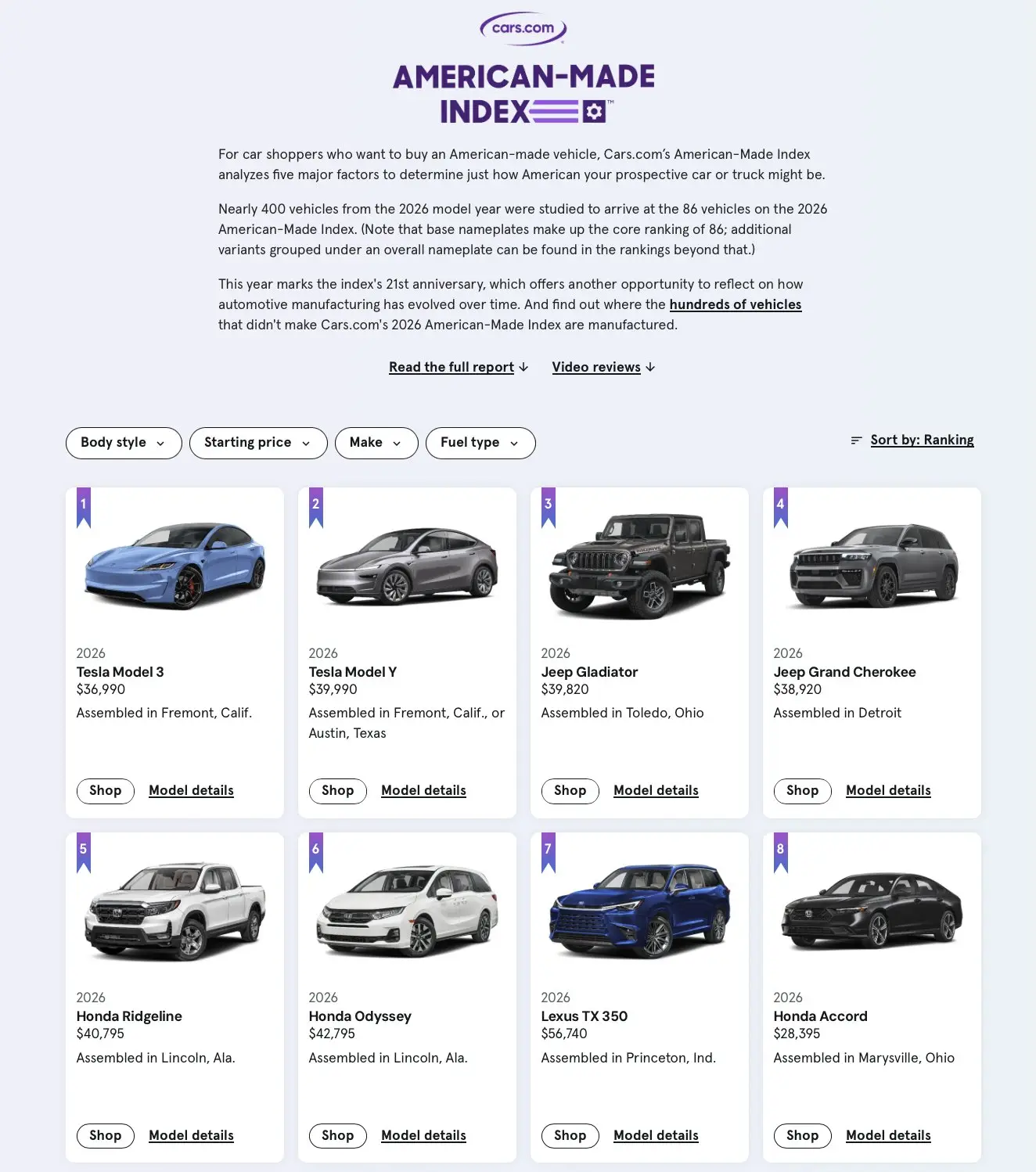
Table of Contents
A simple ranking with a complicated message
According to a post from Sawyer Merritt, the Tesla Model 3 and Model Y were ranked first and second on Cars.com’s 2026 American-Made Index. The claim stands out because it cuts against a common political shortcut: that EVs are somehow less tied to American industry than gas cars.
The American-Made Index is not a perfect measure of patriotism, and it should not be treated that way. But it does ask a practical question. Where is the car assembled? Where do the parts come from? How much of the workforce and supply chain sit in the United States? On those measures, Tesla has a case that is hard to wave away.
For years, the US EV debate has fallen into familiar camps. Supporters talk about climate, software, and lower operating costs. Critics talk about battery minerals, subsidies, charging problems, and rural use. The Cars.com ranking brings the argument back to something more concrete: where is the vehicle actually made?
Why EV manufacturing changes the patriotism debate
The Model 3 and Model Y are not niche EVs. They are mass-market vehicles built at large scale, with US manufacturing at the center of the story. That makes the ranking more than a marketing win. It puts EV adoption inside the larger fight over American industrial capacity.
The United States has spent years trying to rebuild advanced manufacturing around batteries, semiconductors, electric drivetrains, and energy storage. Tesla did not solve that by itself, but it helped prove that high-volume EV production could be anchored domestically. Its factories in California, Nevada, Texas, and other parts of the Tesla ecosystem turned EVs into factory work, not just an environmental preference.
That changes the old auto identity map. A gas pickup with a long international parts chain may feel more traditional. A battery-electric crossover assembled in the United States with high domestic content may score better on actual domestic production. Buyers may still prefer the gas vehicle for practical reasons, but the phrase “real American car” gets less simple.
The supply chain is part of the product
Modern cars are supply chains on wheels. Batteries, motors, chips, castings, software, seats, glass, steel, aluminum, and labor all count. When consumers ask where a vehicle is made, they are really asking where the value is created.
Tesla has pushed more of that value chain closer to its factories. Gigacasting, battery localization, in-house software, and factory integration all point to a model that differs from the supplier-heavy playbook used by traditional automakers. That does not mean Tesla makes everything itself. No automaker does. But Tesla’s vehicle identity is tied closely to its factories.
The Model Y matters most here because it is a mainstream crossover, not a showcase vehicle built in small numbers. When a high-volume family EV ranks near the top of an American-made list, the domestic EV supply chain no longer looks theoretical.
Why buyers may care
Most people do not buy a car because of one index. Price, reliability, range, charging access, insurance, financing, and brand trust usually matter more. Still, the ranking can influence buyers who are torn between EV skepticism and pride in buying American.
For a household that wants to buy American but has heard EVs are mainly an overseas story, Tesla’s ranking complicates the picture. It gives owners, salespeople, and EV advocates a concrete point to make: the EV in the driveway may be one of the most domestically rooted vehicles on sale.
It also matters for fleets. Companies and government agencies often care about domestic content, procurement optics, and operating cost. A vehicle that combines US production with lower energy and maintenance costs can satisfy more than one purchasing goal.
The pressure on Detroit
The uncomfortable part for legacy automakers is that history does not automatically win the next manufacturing cycle. Detroit still has deep roots in American industry, but Tesla can now point to EV volume and American-made rankings at the same time.
That does not mean Ford, GM, or Stellantis are finished. They still have huge factory footprints, truck loyalty, dealer networks, and political pull. But the next decade will be less forgiving of symbolic claims. Consumers and policymakers will ask where batteries are sourced, where software is developed, and where the highest-value parts of the vehicle are produced.
Tesla’s American-made ranking is not just a badge. It is a snapshot of an industry in transition. The most American vehicle may no longer be the one that looks most familiar. It may be the one built around the factories, workers, and supply chains that define the next manufacturing cycle.
That is why the ranking lands harder than a normal brand accolade. It turns a debate about EV identity into a debate about industrial reality. In that debate, Tesla has a stronger argument than many critics want to admit.
Source
- Sawyer Merritt X post on Tesla Model 3 and Model Y in the 2026 American-Made Index: https://x.com/SawyerMerritt/status/2069427602503155856
- Cars.com American-Made Index: https://www.cars.com/american-made-index/
- Tesla Investor Relations: https://ir.tesla.com/
- Tesla Model 3 page: https://www.tesla.com/model3
- Tesla Model Y page: https://www.tesla.com/modely