

 由 Sherry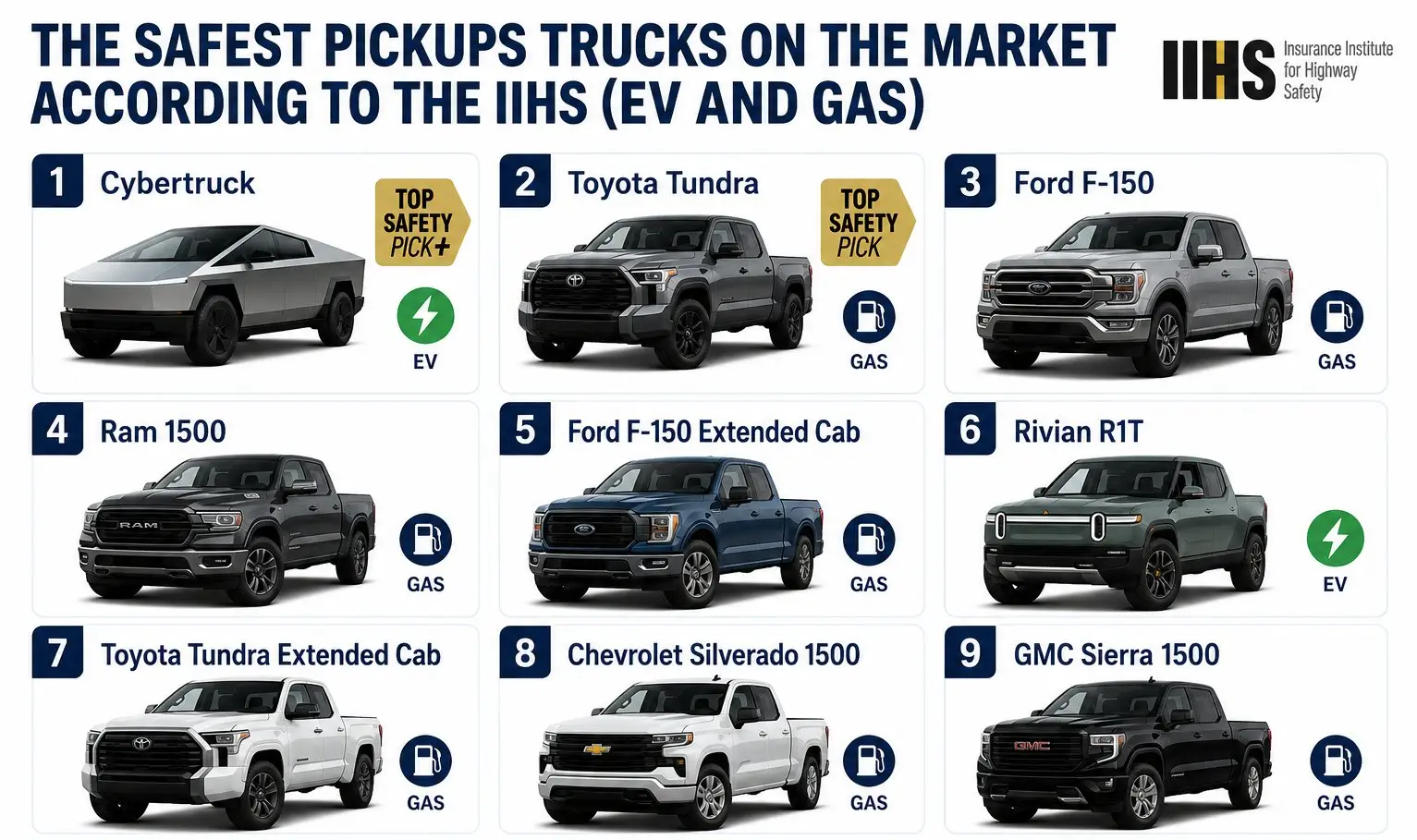
Table of Contents
A polarizing truck gets a conventional test
Cybertruck has rarely been judged like a normal pickup. Before many people had even driven one, it was already loaded with meaning: too strange for some buyers, futuristic for others, and tied tightly to Tesla’s public image. That is why the latest IIHS discussion around large pickups matters. It pulls the safety debate back toward measured results.
Sawyer Merritt highlighted a ranking of the safest large pickup trucks according to IIHS, with Cybertruck listed first and carrying a Top Safety Pick+ designation. Toyota Tundra followed with Top Safety Pick, while Ford F-150, Ram 1500, Rivian R1T, and Chevrolet Silverado 1500 appeared lower in the listed order.
The point is not that Tesla supporters have a new talking point. It is that Cybertruck, a vehicle often judged by what people assume its shape must mean, now has a third-party result that makes the easy narrative harder to repeat.
Why the large-pickup category matters
Large pickups are not niche vehicles in the United States. People use them as commuter cars, family cars, work trucks, fleet vehicles, and status purchases. They also raise real safety questions because size, weight, hood height, and sightlines can affect crash outcomes.
That makes the IIHS large-pickup comparison more than a brand scoreboard. It looks at one of the most influential vehicle categories on American roads. If an electric pickup can rank at the top, it challenges two common assumptions: that EVs are too experimental to lead safety ratings, and that Cybertruck’s unusual design automatically makes it less safe.
Neither assumption should get a free pass. A vehicle can look strange and still do well in structured tests. A familiar-looking truck can still have weak spots. Safety should be judged by performance, not by the shape of the bodywork.
Top Safety Pick+ is not about vibes
IIHS awards are based on defined test and rating criteria, not social-media sentiment. Top Safety Pick+ is the institute’s highest award, and qualifying requires strong performance across crashworthiness and crash-prevention categories. The Cybertruck’s 2026 IIHS page lists it as a Top Safety Pick+ in the large-pickup class.
That gives buyers another piece of information. Pickup shoppers already compare towing, payload, range, bed utility, software, price, and brand loyalty. Safety ratings add a different signal: under the conditions IIHS tests, the vehicle met a high standard.
For Tesla, that matters because Cybertruck invites snap judgments. The stainless-steel exterior, angular body, and heavy road presence make some people assume danger before looking at data. The IIHS result does not put the truck beyond criticism, but it gives the discussion a firmer starting point.
The pedestrian question matters most
Tesla also recently emphasized Cybertruck’s performance in IIHS pedestrian front crash prevention testing, saying the truck avoided every collision across daytime, nighttime, and different-angle scenarios. That part matters because pedestrian safety is one of the hardest issues for large vehicles.
Modern trucks and SUVs have grown taller and heavier. Pedestrians, cyclists, and smaller vehicles are more exposed around them. Active crash prevention cannot cancel physics, but it can reduce some risks if the system detects people reliably and reacts early enough.
For Cybertruck, strong pedestrian crash-prevention results are especially important. The truck’s shape is often discussed as if it must be hostile to pedestrians by default. Test performance does not answer every real-world concern, but it does show that active safety technology belongs in the conversation.
The takeaway is not that Cybertruck is harmless. No large pickup is harmless in every scenario. The better takeaway is that safety has layers: structure, sensors, software, braking, visibility, driver behavior, and crash prevention all matter. The result also does not settle the broader EV-versus-gas pickup debate around charging access, battery cost, capability, and consumer trust. It does change one thing, though: it is now harder to claim that appearance alone proves poor safety performance.
A better way to talk about Cybertruck safety
Cybertruck’s IIHS ranking should push the conversation toward better questions. How did it perform in each test category? How does it compare with gas pickups and other EVs? Which safety features are standard? How will real-world crash data develop over time? How well does it protect people outside the cabin?
That last question may become the most important one. The next phase of vehicle safety will be judged not only by how well occupants survive crashes, but by how often vehicles avoid creating crashes in the first place.
Cybertruck is still polarizing, and that will not change quickly. But a top IIHS result gives Tesla something stronger than hype. It shows that even the strangest-looking truck on the market can be evaluated by ordinary standards: tests, ratings, categories, and evidence. Cybertruck does not need to be loved to be measured fairly.
Source
- Sawyer Merritt X post on IIHS large pickup safety ranking: https://x.com/SawyerMerritt/status/2069596858062713063
- IIHS 2026 Tesla Cybertruck ratings page: https://www.iihs.org/ratings/vehicle/tesla/cybertruck-crew-cab-pickup/2026
- IIHS Top Safety Picks page: https://www.iihs.org/ratings/top-safety-picks
- Tesla X post on Cybertruck IIHS pedestrian front crash prevention: https://x.com/Tesla/status/2069588778063438255
- NHTSA vehicle safety and automated vehicles safety page: https://www.nhtsa.gov/vehicle-safety/automated-vehicles-safety