

 由 Sherry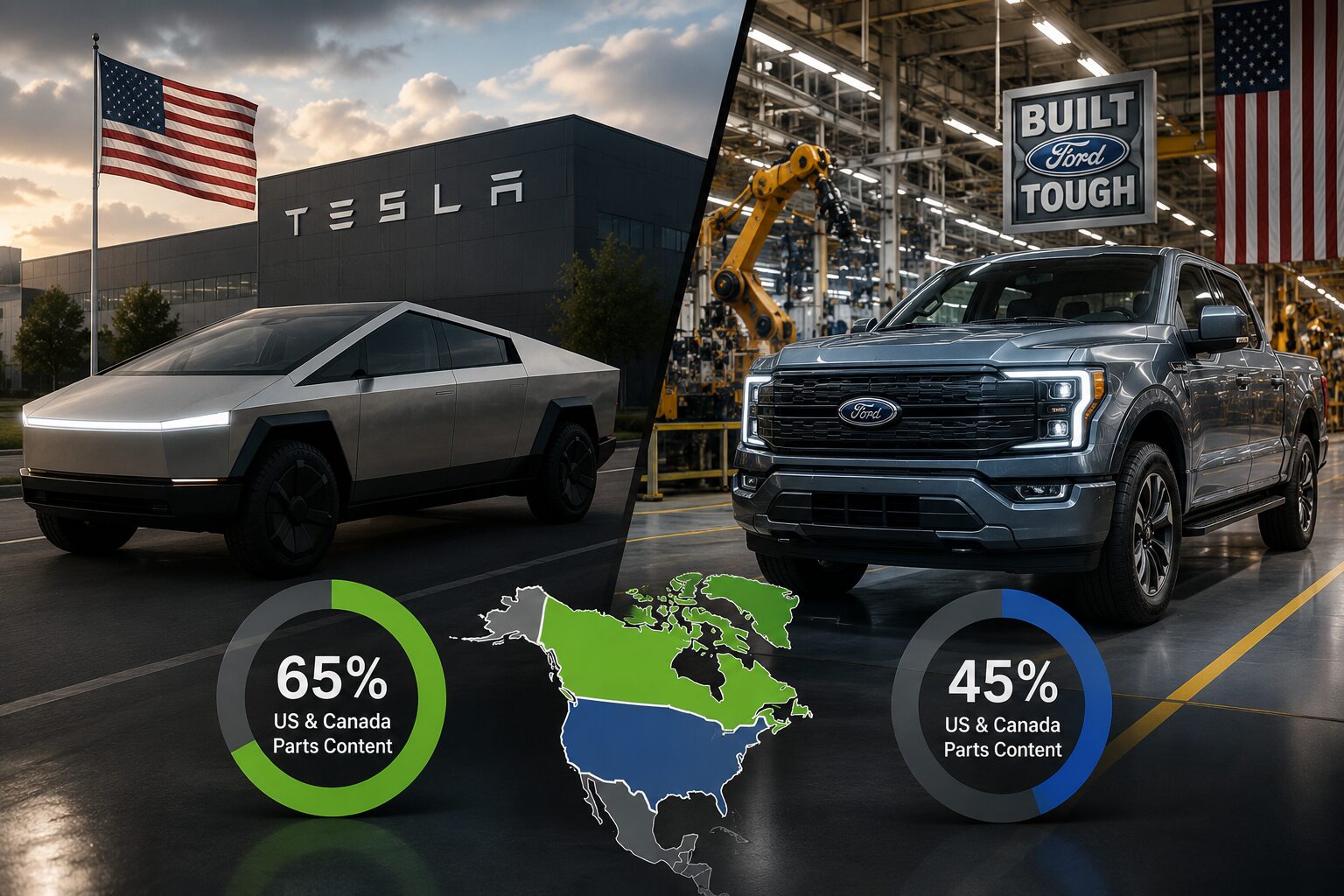
Table of Contents
What the federal label says
A social post comparing the Tesla Cybertruck and Ford F-150 cited two striking figures: 65% US and Canadian parts content for the Cybertruck and 45% for the F-150. NHTSA’s model-year 2026 data under the American Automobile Labeling Act supports those numbers.
The federal sheet says both trucks are finally assembled in the United States. For Cybertruck, it lists the United States as the origin of the motor and transmission and Mexico as the source of 25% of parts content. Tesla identifies Giga Texas as the truck’s production home. The F-150 entry also lists US assembly, along with US origins for the engines and transmission configurations shown.
Under the AALA formula, then, the Cybertruck carline has a higher reported share of US and Canadian parts value than the F-150 carline.
Why the 65 percent figure matters
Automotive supply chains stretch across hundreds of suppliers and several countries. A 65% US and Canadian figure means that a large share of the Cybertruck’s component value comes from the two-country region used by the label.
That has an economic effect beyond final assembly. Components support work in castings, electronics, glass, seats, battery systems, motors and tooling. Higher regional content suggests that more of this activity sits closer to the assembly plant.
The result also pushes against the idea that EVs necessarily weaken North American manufacturing. Cybertruck combines an electric drivetrain with relatively high regional parts content. Its stainless-steel body and Texas factory make it an unusual product, but the truck is more than an imported powertrain fitted to a domestic body.
Why it is not a complete ranking
The phrase ‘most American-made’ claims more than the AALA percentage can prove. NHTSA’s label covers US and Canadian parts content, major foreign sources, final assembly and the origin of the engine or motor and transmission. It excludes assembly labor, distribution and other costs outside the parts calculation.
Because Canada and the United States are combined, the 65% number does not show each country’s share. It is also a carline average, not a trace of every component in one truck. Trims and powertrains can share a line-level figure even when their exact suppliers differ.
The label says nothing about headquarters, research, corporate ownership, dealer jobs or where profits are invested. Cars.com’s American-Made Index uses a wider method that includes assembly, parts content, engine and transmission origins and US manufacturing employment. It answers a different question, so its ranking can be different too.
Electric trucks change the supply chain
Electrification also changes familiar categories. A gasoline truck uses an engine and a multi-speed transmission built through mature supplier networks. An EV replaces them with motors, inverters and a large battery whose materials and cells may cross several borders before assembly.
AALA reporting reduces that complexity to a percentage and a few country codes. That makes comparison easier, but it cannot show whether a battery cell, semiconductor or refined mineral is hard to replace. A relatively low-value component can still stop production.
Assembly incentives alone therefore do not create a durable domestic EV industry. Battery materials, cell plants, power electronics and capable suppliers matter too. Local sourcing may reduce tariff and shipping exposure for automakers, provided those suppliers remain competitive on cost.
How to read ‘American-made’ claims
Buyers interested in domestic manufacturing should look beyond one slogan. Assembly location and AALA parts content are useful starting points. Motor, engine and transmission origins add context, as do US manufacturing employment and the stability of regional suppliers.
On one official measure, Cybertruck leads the F-150 by 65% to 45%. That is noteworthy given the Ford’s place in American truck culture. It does not make the F-150 foreign, and it does not turn a parts label into a full account of either company’s economic activity.
‘American-made’ is better understood as a collection of sourcing and production decisions than a yes-or-no label. Cybertruck’s number shows substantial regional sourcing. The limits of the data explain why no single percentage can describe the entire truck.
Source
- Sawyer Merritt post: https://x.com/SawyerMerritt/status/2071393346153599167
- NHTSA model-year 2026 AALA percentage report: https://www.nhtsa.gov/sites/nhtsa.gov/files/2026-06/MY2026-AALA-Percentage-06-08-26.pdf
- NHTSA AALA reports and methodology overview: https://www.nhtsa.gov/part-583-american-automobile-labeling-act-reports
- Tesla Giga Texas: https://www.tesla.com/en_in/giga-texas
- Cars.com 2026 American-Made Index: https://www.cars.com/articles/2026-cars-com-american-made-index-which-cars-are-the-most-american-526147/