

 由 Sherry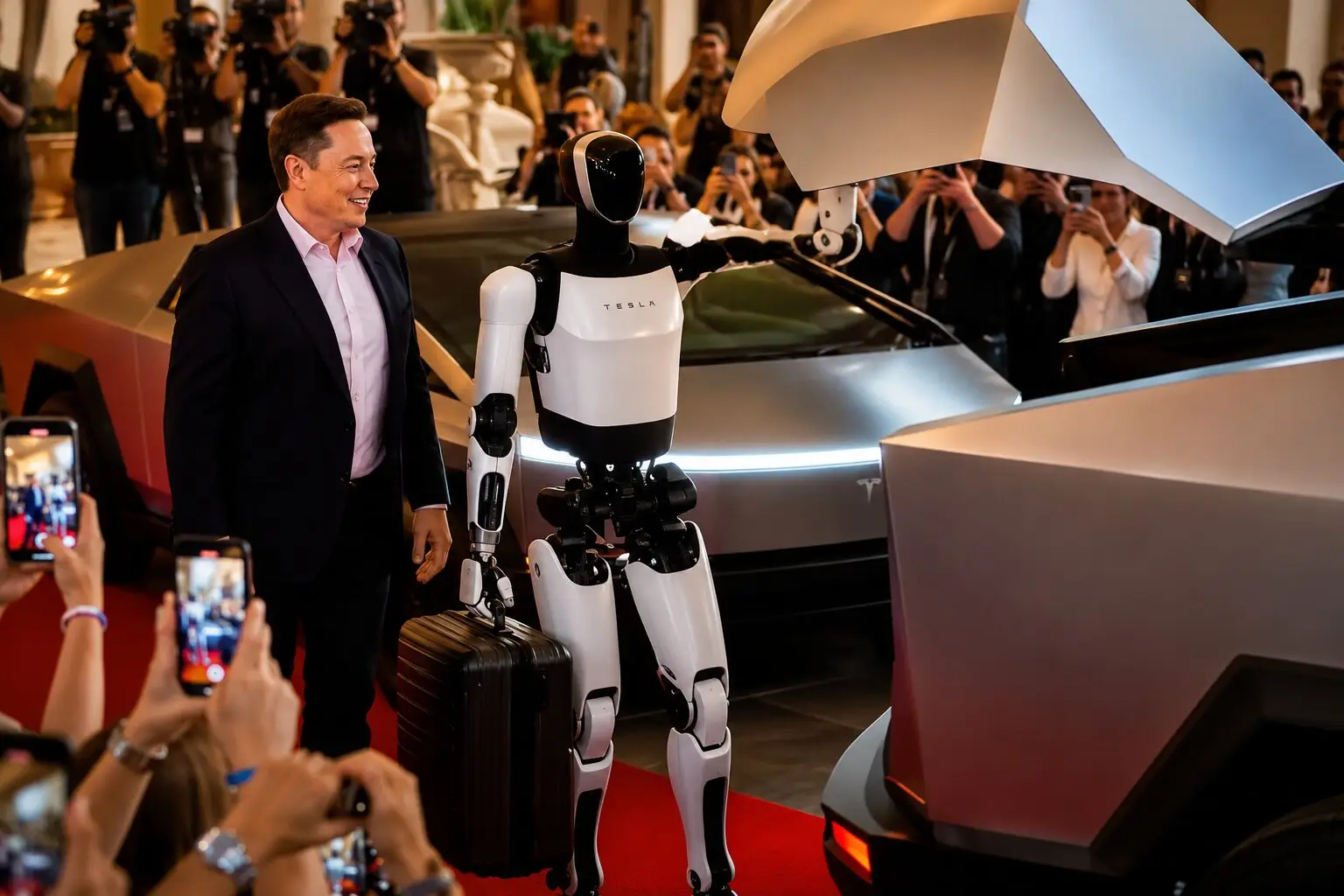
Table of Contents
A Better Demo Because It Looks Boring
A recent video shows Tesla’s Optimus walking while moving rolling suitcases at a public event as Elon Musk looks on. The clip is brief, polished and easy to share. It also invites the usual extremes: either humanoid robots have arrived, or the whole thing is theater.
The useful interpretation sits between those reactions. Moving luggage is not a revolutionary capability by itself. Humans do it without thinking. For a humanoid robot, however, the task combines locomotion, balance, grasping and environmental awareness in a way that is closer to real work than dancing on a stage.
Tesla describes Optimus as a general-purpose biped intended for unsafe, repetitive or boring tasks. If that goal is serious, the robot must eventually become excellent at activities that barely deserve a video: carrying bins, opening doors, moving carts and transporting objects between rooms.
The path to a valuable household or workplace robot runs through thousands of boring jobs performed reliably.
Luggage Is a Compound Robotics Test
A wheeled suitcase looks simple because the floor supports most of its weight. Yet the robot still needs to identify a usable handle, place its hand accurately and maintain a stable grip as the bag changes direction. The wheels introduce drag, small impacts and sideways forces that affect the robot’s balance.
Walking with an object also changes motion planning. Optimus must account for the bag occupying space behind or beside it. It needs to avoid clipping furniture, people or another suitcase while keeping its own feet clear. A turn that works for an empty-handed robot may pull the luggage into an obstacle.
Public spaces add uncertainty. Floors may slope. Carpet creates more resistance than polished concrete. People cross unexpectedly. Handles differ in height and shape. A robot that succeeds with one prepared suitcase on a clear route has demonstrated a useful building block, not a finished product.
That is why ordinary tasks can be revealing. Their apparent simplicity makes failures difficult to excuse. A general-purpose machine should not need a custom environment for every object it encounters.
The Missing Question Is Autonomy
The clip does not establish how Optimus was controlled. It may have operated autonomously, followed a planned sequence, received remote guidance or combined those methods. Without a technical explanation, viewers should not infer more than the video shows.
This distinction matters because teleoperation can produce impressive movement while leaving the hardest intelligence problem unsolved. Remote control is not useless. It can help collect training data, supervise early deployments and allow a human to resolve unusual situations. But it changes the economics.
A household robot that requires one remote operator for every machine does not eliminate much labor. A factory robot that needs occasional assistance across a large fleet can still be valuable. The key metric is how often human intervention is required and how quickly the robot can return to work afterward.
Tesla’s official description emphasizes vision, planning, balance, navigation and interaction with the physical world. Demonstrations should increasingly clarify which of those capabilities are running onboard and which depend on human support.
Useful Work Requires Recovery
Successful task completion receives most of the attention. Commercial value often depends on recovery from failure.
What happens if the suitcase tips over, the handle collapses or a wheel catches on a threshold? Can the robot recognize the problem, set the object down safely and try another strategy? Can it ask for help without creating a hazard? Can it resume after someone moves the bag?
These situations separate a demonstration from an operating system. Homes and workplaces are full of partially open doors, misplaced objects and people who do not behave as expected. A robot cannot simply stop indefinitely whenever reality differs from its training example.
Safety also extends beyond avoiding a fall. Optimus must limit the force applied to handles, protect nearby people and place objects without damaging them. The more general the robot becomes, the more carefully it must judge contact.
Progress Should Be Measured in Unscripted Hours
The suitcase video is a reasonable progress signal, but the next evidence should be less cinematic. How many hours can Optimus work in an ordinary environment? How many object types can it handle? How frequently does it request assistance? How long does a task take compared with a person, and what happens after a mistake?
Those measurements would make a robot look less magical and more like a product. That is a healthy transition.
Humanoid robots will not become useful because one machine walks confidently across a red carpet. They will become useful when fleets can perform mundane jobs for long periods without careful staging or constant rescue. Carrying luggage points toward that future precisely because the destination is so ordinary.
Source
- Constitutional Patriot post: https://x.com/ConstitustionX/status/2072507790506213412
- Tesla AI and Robotics: https://www.tesla.com/AI
- Tesla We, Robot event recap: https://www.tesla.com/we-robot
- Tesla Q1 2026 Update: https://ir.tesla.com/_flysystem/s3/sec/000162828026026551/tsla-20260422-gen.pdf
- Tesla 2025 Annual Report: https://ir.tesla.com/_flysystem/s3/sec/000162828026003837/tsla-20260128-gen.pdf