

 由 Sherry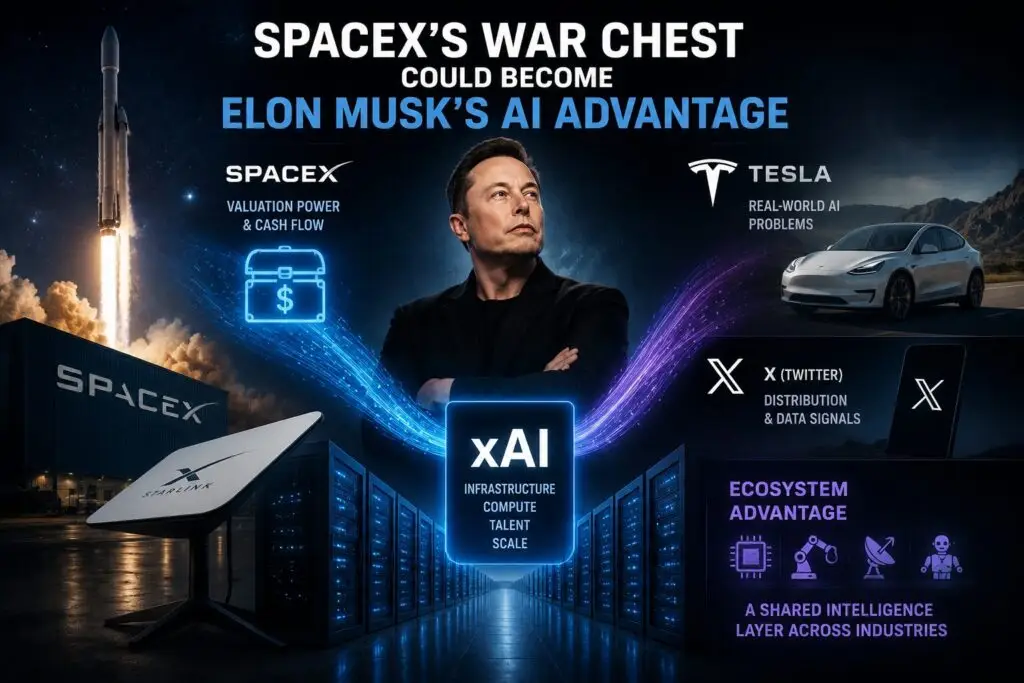
Table of Contents
Why AI Needs a War Chest
The modern AI race is brutally expensive. Building a competitive frontier model requires chips, data centers, energy, talent, networking equipment, and years of operating losses before the business model becomes clear. That is why the biggest players are not only AI labs. They are companies with access to enormous capital: Microsoft, Google, Meta, Amazon, and OpenAI’s investor network.
Elon Musk’s xAI faces that same problem. It has ambition, talent, and distribution through X, but ambition alone does not buy GPUs. The Wall Street Journal’s framing of Musk “unleashing SpaceX’s new war chest” captures the core issue: Musk’s AI challenge is not only model quality. It is whether he can fund enough infrastructure to keep up.
In AI, compute is strategy.
SpaceX Is Not Just a Rocket Company Anymore
SpaceX has become one of Musk’s most powerful financial assets. Its launch business dominates much of the global commercial launch market, and Starlink has turned the company into a satellite internet provider with recurring revenue potential. That combination gives SpaceX something most startups do not have: strategic cash flow and a valuation story that can support major capital raising.
That matters for xAI because Musk’s companies increasingly operate like an ecosystem. Tesla provides vehicles, robotics ambitions, and real-world AI problems. X provides consumer distribution and data signals. SpaceX provides engineering culture and possibly financial firepower. xAI provides the model layer.
The question is whether SpaceX’s financial strength can help solve the scale problem that every serious AI lab faces.
Musk’s AI Problem Is Infrastructure
xAI’s Grok is not competing in a vacuum. It is competing against models backed by hyperscalers with deep cloud infrastructure. OpenAI has Microsoft. Anthropic has Amazon and Google ties. Google has its own TPUs and data centers. Meta is spending heavily on AI infrastructure.
For xAI, the challenge is simple to state and hard to solve: it needs enough compute to train and serve models at scale. That means massive capital commitments before the payoff is certain.
Musk has tried to move fast. xAI has built large clusters, integrated Grok into X, and positioned itself as a more irreverent, real-time AI alternative. But speed does not remove the cost curve. AI infrastructure is not a side project. It is the product factory.
If SpaceX capital helps xAI expand compute, Musk could narrow the infrastructure gap faster than a normal startup could.
The Advantage of a Company Network
Musk’s unusual advantage is that his companies can reinforce each other. Tesla’s autonomy and robotics work needs AI. X needs AI search, content tools, and agents. SpaceX and Starlink could benefit from AI in operations, customer support, network optimization, and engineering workflows. xAI can become a shared intelligence layer across the ecosystem.
That is the bullish view. Instead of treating xAI as another standalone chatbot company, Musk may see it as the AI engine for a broader industrial network.
This matters because enterprise AI is often criticized for lacking clear use cases. Musk’s companies have obvious use cases: autonomous driving, manufacturing, rockets, robotics, satellites, customer support, logistics, and software automation. If xAI becomes useful inside that network, it gets a proving ground other AI labs cannot easily copy.
The Risks of Cross-Company Gravity
The risk is that this network can become too tangled.
SpaceX investors may not want their capital used to solve problems at xAI. Tesla shareholders may worry that Musk’s attention is spread too thin. Regulators may look closely at related-party transactions. Employees may wonder which mission matters most. Customers may not care about ecosystem theory if products lag.
There is also a strategic risk. AI companies need focus. SpaceX succeeds because it is intensely operational. xAI will need the same discipline. Money can buy compute, but it cannot guarantee product-market fit, model leadership, or trust.
Still, the logic is clear. Musk’s AI problem is too expensive to solve with charisma alone. It needs capital, infrastructure, and distribution. SpaceX may be the strongest source of the first two.
If Musk can turn SpaceX’s financial strength into xAI’s infrastructure advantage without damaging SpaceX’s own mission, he may build something larger than a chatbot company. He may build an AI layer for his entire industrial empire.
That is the real story: SpaceX’s war chest is not only about rockets. It may become fuel for Musk’s AI race.
Source
- Wall Street Journal: https://www.wsj.com/tech/ai/elon-musk-is-unleashing-spacexs-new-war-chest-to-solve-his-ai-problem-255f4969
- xAI Grok: https://x.ai/grok
- SpaceX Starlink: https://www.starlink.com