

 由 Sherry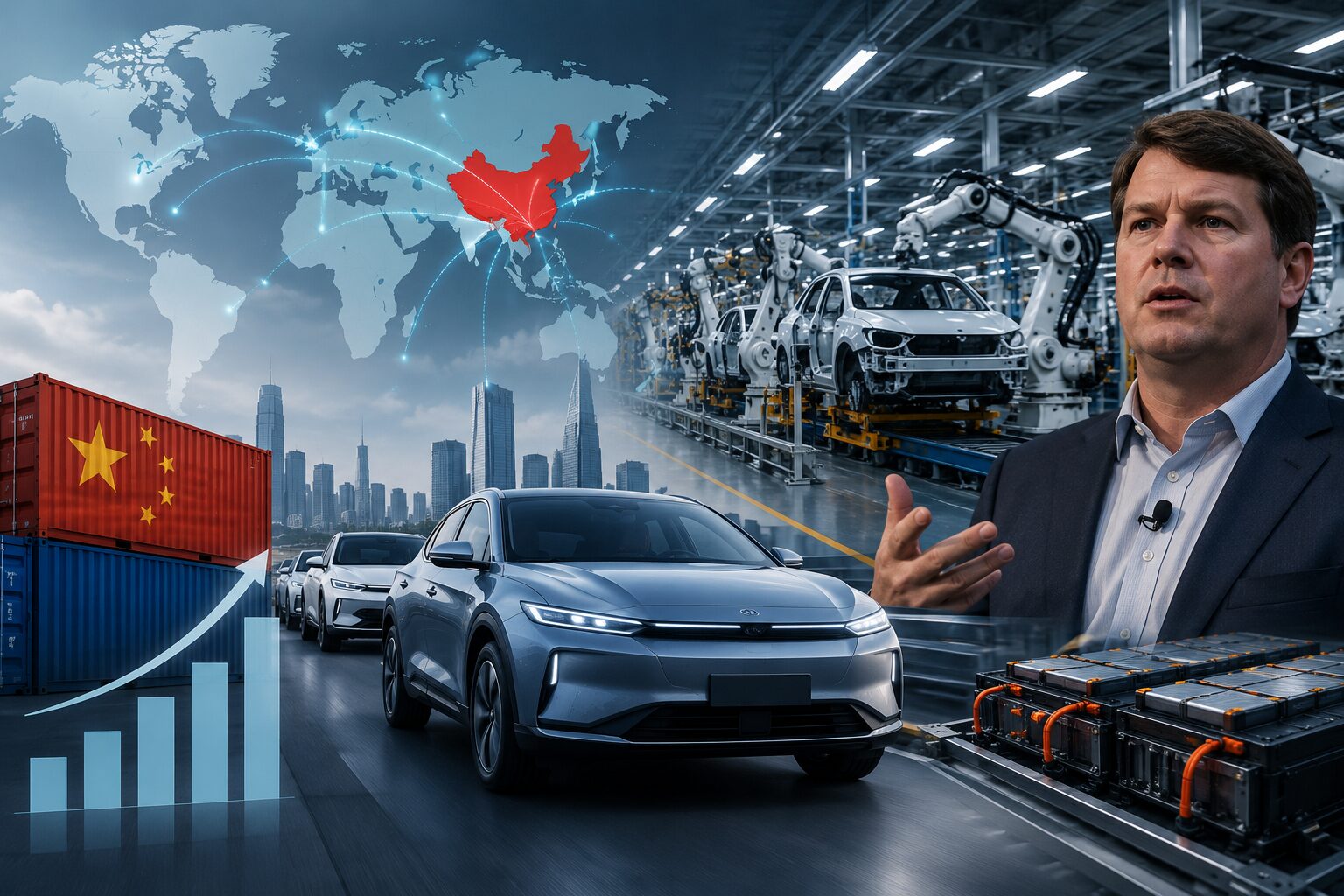
Table of Contents
Farley’s warning goes beyond Tesla
Ford CEO Jim Farley has repeatedly called Chinese automakers the toughest competition in electric vehicles. In a resurfaced interview clip, he said Tesla, General Motors and Ford do not offer serious competition to what he has seen in China, which he described as dominating the global EV market.
Read as a sales ranking, the claim sounds overstated. Tesla’s Model 3 and Model Y remain major global products, and the International Energy Agency says Model Y accounted for nearly 8% of worldwide battery-electric sales in 2025. Farley appears to be talking about the industry around the cars. China has many automakers, battery companies, electronics suppliers and factories competing at nearly every price point.
That network is harder to challenge than a single brand, especially when most North American EV lineups still lean toward expensive models.
Scale speeds up learning
The IEA estimates that China built nearly 75% of the world’s electric cars in 2025. More than 13 million EVs were sold in the country, close to 55% of all new-car sales there. Chinese companies also accounted for more than half of global battery-electric model availability and sales.
Large volumes lower component costs, but they also give companies feedback more quickly. In a market where many buyers already consider an electrified car, manufacturers can learn faster about charging, software, cabin features and price. Suppliers receive enough orders to justify specialized equipment, while engineers see competing ideas reach customers in rapid succession.
The pressure therefore extends beyond BYD or any other well-known brand. It includes a supplier base that can respond quickly when a battery chemistry, manufacturing method or feature proves useful.
Lower prices begin with product design
Subsidies and labor costs help explain Chinese EV pricing, but they are not the whole explanation. The IEA says nearly 70% of battery-electric cars sold in China during 2025 cost less than comparable combustion vehicles even before incentives.
Much of that saving is built into the vehicle. Lithium-iron-phosphate batteries avoid nickel and cobalt. Integrated electronics reduce the number of separate control units and wiring. Shared platforms spread engineering costs across several models, and high domestic demand keeps factories busy.
Chinese automakers also put connected services, software and large displays into lower-priced cars. Western manufacturers face two jobs at once: cut hardware costs and improve the digital experience without pushing the vehicle back into a premium price bracket.
Tariffs buy time, not manufacturing skill
Trade barriers can slow imports and give domestic factories time to invest. They cannot teach a company to earn money on a $30,000 EV. They also cannot remove China from the battery supply chain. The IEA says China produced more than 80% of global battery cells in 2025 and held even larger shares in several active materials.
Chinese automakers are also gaining experience outside their home market. Electric-car exports exceeded 2.5 million in 2025, double the previous level, and first-quarter 2026 exports more than doubled again year over year. Latin America, Southeast Asia and the Middle East are giving these brands experience even when the United States remains difficult to enter.
Protected markets may avoid direct competition for a while, but Chinese manufacturers continue learning from customers abroad during that time.
Ford’s response starts in the factory
Ford’s Universal EV Platform acknowledges that another premium electric truck built on a conventional cost structure will not close the gap. Ford plans to invest about $5 billion in manufacturing and battery operations. The first vehicle is scheduled to be a four-door midsize electric pickup starting around $30,000 in 2027.
Ford says the platform uses a structural LFP battery and a simpler production process. The goal is to support a family of affordable vehicles, rather than design one low-cost truck in isolation. That gives Ford a chance to reuse the same cost reductions across several products.
There is plenty left to prove. Target prices often rise before production, and competitors have until 2027 to improve. Ford must show that the new assembly method works at volume, that suppliers can hit the cost targets and that the software improves after customers take delivery.
Farley’s comments are not a claim that every Chinese EV is better, nor are they an admission of defeat. They are a warning that Detroit is competing with an entire production network. Its response will depend on how cheaply and quickly it can build batteries, electronics and software into cars people can afford.
Source
- Sawyer Merritt post with Jim Farley interview clip: https://x.com/SawyerMerritt/status/2071774046992109849
- IEA Global EV Outlook 2026 trends: https://www.iea.org/reports/global-ev-outlook-2026/trends-in-electric-cars
- IEA Global EV Outlook 2026 executive summary: https://www.iea.org/reports/global-ev-outlook-2026/executive-summary
- IEA EV manufacturing and trade analysis: https://www.iea.org/reports/global-ev-outlook-2026/manufacturing-and-trade
- Ford Universal EV Platform announcement: https://www.fromtheroad.ford.com/us/en/articles/2025/ford-affordable-electric-vehicle-platform-midsize-electric-truck
- Ford platform simplicity overview: https://www.fromtheroad.ford.com/us/en/articles/2025/simplicity-blueprint-future-ford-electric-vehicle-platform