

 由 Sherry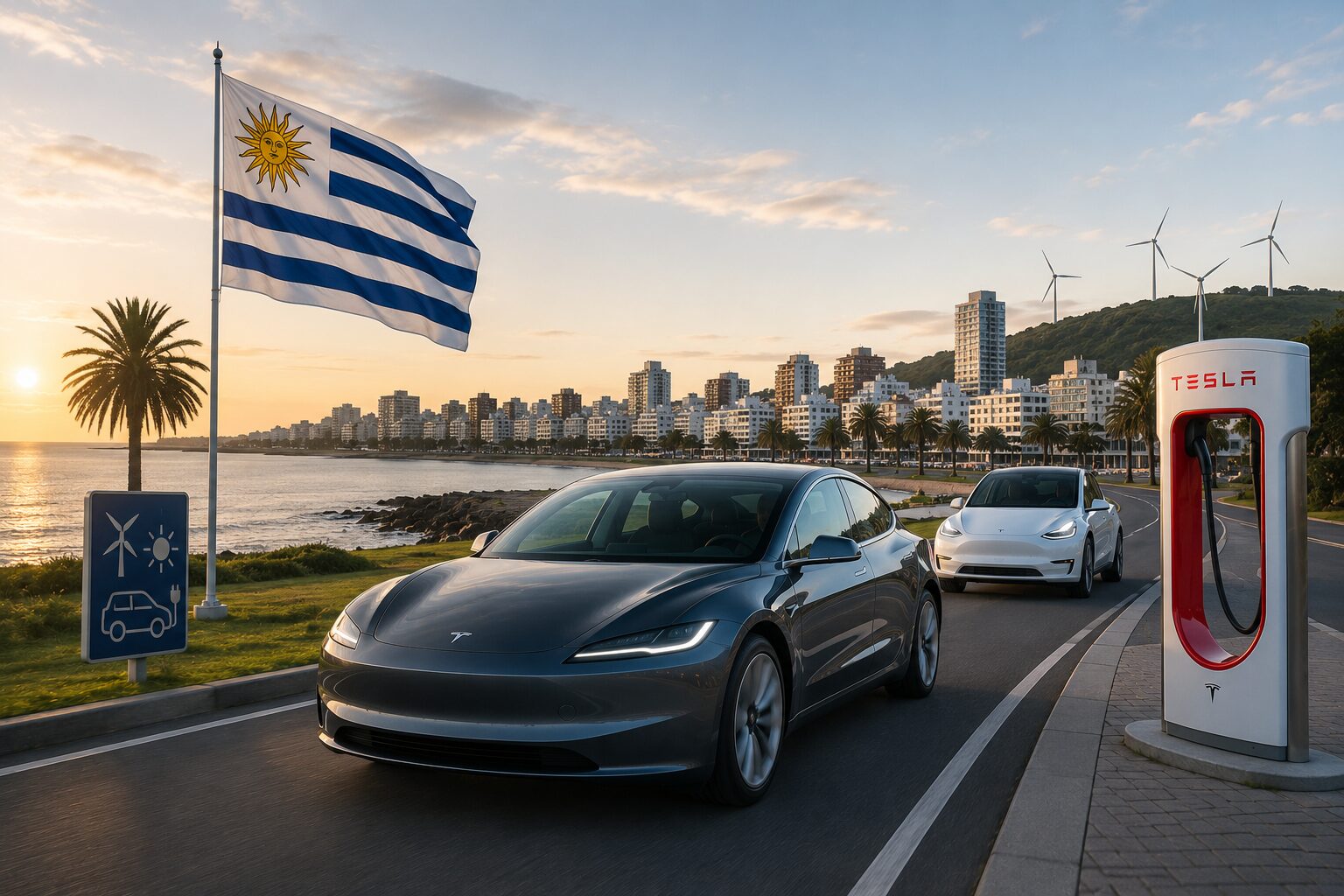
Table of Contents
A small market with strong EV conditions
Tesla’s Latin American account has announced that Model 3 and Model Y sales are coming to Uruguay. The country is too small to change Tesla’s quarterly delivery totals, and imported cars remain expensive. It does, however, offer established policies and a power grid that suit EV ownership.
Uruguay has supported electric mobility with lower vehicle taxes, insurance discounts, financing and charging rates. For 2026, the Ministry of Industry, Energy and Mining says new electric cars pay an annual vehicle tax equal to 3% of market value excluding VAT, compared with 5% for new combustion cars. Eligible EVs also receive a 15% discount from the state insurance provider.
Those policies reduce ownership costs without removing them. Tesla will enter a market where buyers already understand EVs and have alternatives from other manufacturers.
Clean electricity changes the calculation
Uruguay’s electricity mix may matter more than its purchase incentives. Uruguay XXI says renewable sources provide 99% of the country’s electricity, with wind and hydropower joined by biomass and solar generation.
An EV charged on that grid has lower operating emissions than one charged mainly with coal or gas. The energy-security case is also straightforward. Uruguay imports petroleum, while it can produce much of the electricity used by EVs at home. Moving daily travel away from gasoline reduces some exposure to changing oil prices.
Buyers still have to balance a higher purchase price against lower energy and routine maintenance costs. Uruguay’s policy framework encourages that total-cost comparison. Tesla’s arrival may make it more visible, particularly for people with predictable commutes and a place to charge at home.
Model 3 and Model Y serve different buyers
Selling both models gives Tesla two familiar options. Model 3 is an efficient electric sedan with strong performance and technology. Model Y offers more cargo room, a higher seating position and the crossover body style that now attracts many family buyers.
Neither model is certain to be inexpensive after shipping, taxes and currency movements. Tesla’s direct-sales model may make pricing simpler, but Chinese EV brands have expanded quickly across emerging markets and often compete aggressively on price. The IEA says lower-cost Chinese vehicles have driven much of the recent EV growth outside China, Europe and the United States.
Tesla will therefore need more than novelty. Efficiency, integrated software, charging and brand recognition may help. Price could be the weak point when buyers compare the cars with increasingly capable Chinese alternatives.
Tesla still has to earn local trust
The announcement is the easy part. Owners also need deliveries, spare parts, collision repair and trained technicians. Roadside help and warranty service have to work. In a small market, one long wait for a component can shape how many people view the brand.
Charging is another practical test. Uruguay’s compact size reduces long-distance concerns, and the national utility has promoted electric transport. Tesla still needs to explain public-charger compatibility, route planning and home installation. At first, making the existing network easy to use may matter more than building a large proprietary Supercharger network.
Local specifications also need to be clear. Range ratings, charging equipment, connectivity and driver-assistance features can vary by country. Buyers should know what works at delivery instead of assuming that everything shown in US marketing is included.
What Tesla can learn from Uruguay
Uruguay gives Tesla a manageable starting point for a wider South American strategy. Stable institutions, an established EV policy and a renewable grid remove some uncertainty. The company can learn about regional logistics, Spanish-language support, financing and charging behavior without immediately taking on the scale of Brazil or Argentina.
The country may also show how EV demand changes as incentives are reduced. Uruguay’s government has discussed reviewing tax support as adoption rises. If that happens, buyers will place more weight on the vehicle’s price and operating costs.
Tesla is not bringing electric cars to a market that lacked them. Uruguay’s transition was already underway, and other brands are already competing for buyers. Tesla is entering because the market has developed enough to justify the effort.
The test now is ordinary retail execution. Tesla needs competitive prices, dependable support and cars configured for local conditions. Uruguay has already done much of the policy and energy work; Tesla has to show that its ownership experience fits the market.
Source
- Sawyer Merritt post: https://x.com/SawyerMerritt/status/2071758083085197609
- Tesla Latin America announcement: https://x.com/Tesla_LatAm/status/2071757762133123153
- Uruguay Ministry of Industry EV benefits for 2026: https://www.gub.uy/ministerio-industria-energia-mineria/politicas-y-gestion/otros-beneficios-aplicables-vehiculos-electricos
- Uruguay Ministry of Industry electric mobility portal: https://www.gub.uy/ministerio-industria-energia-mineria/tematica/movilidad-electrica
- Uruguay XXI renewable-energy overview: https://www.uruguayxxi.gub.uy/en/news/article/uruguay-consolidates-its-leadership-in-renewable-energy-and-opens-a-new-phase-of-strategic-investments/
- IEA Global EV Outlook 2026 trends: https://www.iea.org/reports/global-ev-outlook-2026/trends-in-electric-cars