

 由 Sherry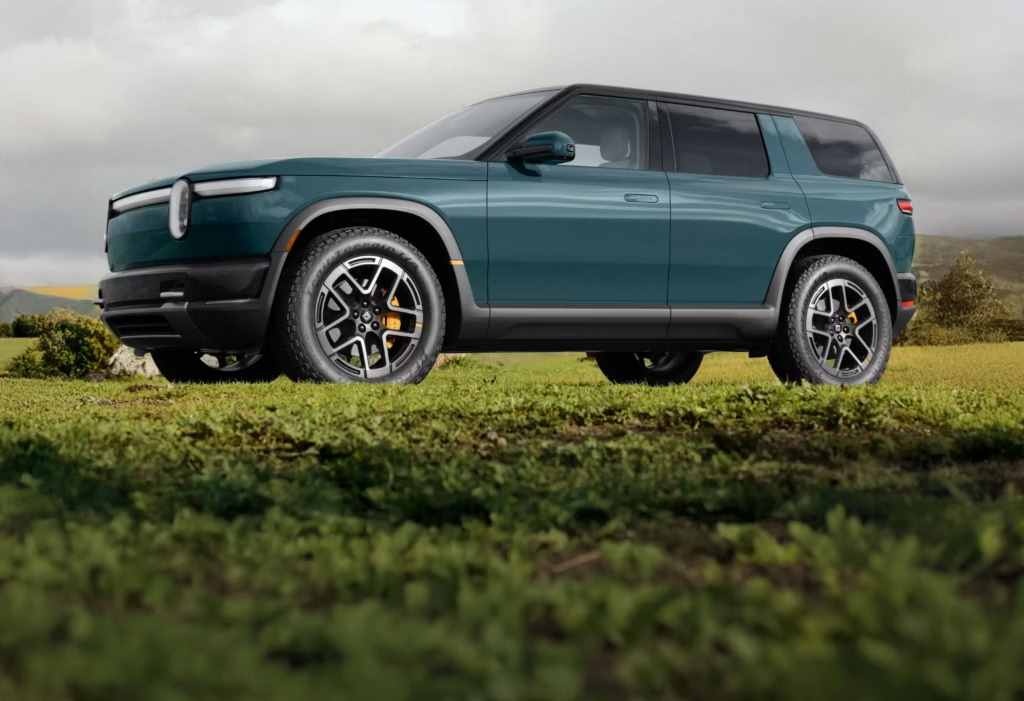
Table of Contents
The Hard Part Comes Before R2 Arrives
Rivian’s layoffs are a reminder that the company’s next phase will be measured by execution more than excitement. The R2 has drawn attention as Rivian’s lower-cost, higher-volume SUV. It is the vehicle investors and customers hope will turn Rivian from a premium adventure EV maker into a broader EV company.
But before R2 can do that, Rivian has to survive the cost discipline required to launch it.
The Wall Street Journal reported that Rivian is laying off hundreds of workers. That kind of move is painful, but not surprising in today’s EV market. Capital is more expensive, demand growth is uneven, and investors are less willing to fund losses indefinitely. Rivian must prove it can move toward profitability while still investing in new products, software, manufacturing, and service.
That is a brutal combination.
Why Layoffs Hit Differently at an EV Startup
Every automaker cuts costs at some point. But layoffs at an EV startup carry a different signal because the company is still proving its scale.
Tesla went through its own years of production stress before reaching sustained profitability. Rivian is still in that earlier, more fragile stage. It has strong products, real customers, and a clear brand identity, but it also has high costs and a difficult path to mass production.
Rivian’s challenge is that it cannot simply shrink into profitability. It needs to cut costs while preparing for growth. That means the company has to protect the teams and capabilities most important to R2, software, manufacturing efficiency, and supplier management.
Bad cost cuts can weaken the future. Good cost cuts remove complexity and sharpen focus.
The difference will matter.
R2 Has to Change Rivian’s Cost Structure
The R2 is not just another model. It is supposed to be Rivian’s cost reset.
The vehicle starts at $44,990 according to Rivian’s official page, far below the R1S and R1T. That lower price requires a different manufacturing mindset. Rivian cannot build R2 with the cost structure of a low-volume premium vehicle. It needs simplified assembly, supplier discipline, high utilization, and fewer expensive surprises.
That is why layoffs and R2 belong in the same conversation. A company preparing for a major product launch has to decide what kind of organization it needs. It may need fewer experimental projects and more focus on execution. It may need tighter spending, clearer accountability, and faster production learning.
R2’s success will depend on whether Rivian can deliver a desirable vehicle without carrying too much cost into every unit.
The Market Is Less Forgiving Now
The EV market has changed. A few years ago, investors rewarded growth stories and reservations. Today they ask harder questions: What is gross margin? What is cash burn? Can the company finance its factory plans? Will demand hold without heavy incentives? Can service scale with deliveries?
Rivian also faces more competition. Tesla remains aggressive. Hyundai and Kia are strong. GM and Ford are more cautious but still present. Chinese EV makers are reshaping global price expectations. Consumers have more choices and less patience for expensive promises.
In that environment, Rivian cannot rely only on goodwill. The R2 has to arrive at the right price, with the right quality, and with credible lease economics. It also has to avoid production delays that would let competitors fill the space.
Layoffs may help preserve cash, but they do not guarantee execution. They only create the possibility of a leaner company.
The Real Question Is Operating Discipline
Rivian has a brand many automakers would envy. Its vehicles feel distinct. Its design language is recognizable. Its customer base is passionate. The R2 gives it a credible shot at a bigger market.
But the next test is not whether people like Rivian. Many do.
The test is whether Rivian can operate like a scaled automaker while still feeling like Rivian. That means controlling costs, delivering vehicles on time, supporting customers, improving software, and building enough units without destroying margins.
The layoffs are a sign of pressure. They may also be part of the discipline Rivian needs before R2 enters production. The risk is that cost cutting becomes a symptom of weakness rather than a tool for focus.
Rivian’s future will not be decided by layoffs alone. It will be decided by what the company protects after the cuts.
If R2 launches cleanly, the layoffs may be remembered as part of a painful but necessary reset. If R2 struggles, they will look like an early warning that the company was trying to do too much with too little room for error.
For Rivian, the R2 is the product. But the company behind it is the real test.
Source
- Wall Street Journal: https://www.wsj.com/business/autos/ev-startup-rivian-lays-off-hundreds-of-workers-40033fc8
- Rivian R2 official page: https://rivian.com/r2
- Rivian investor relations: https://rivian.com/investors