

 由 Sherry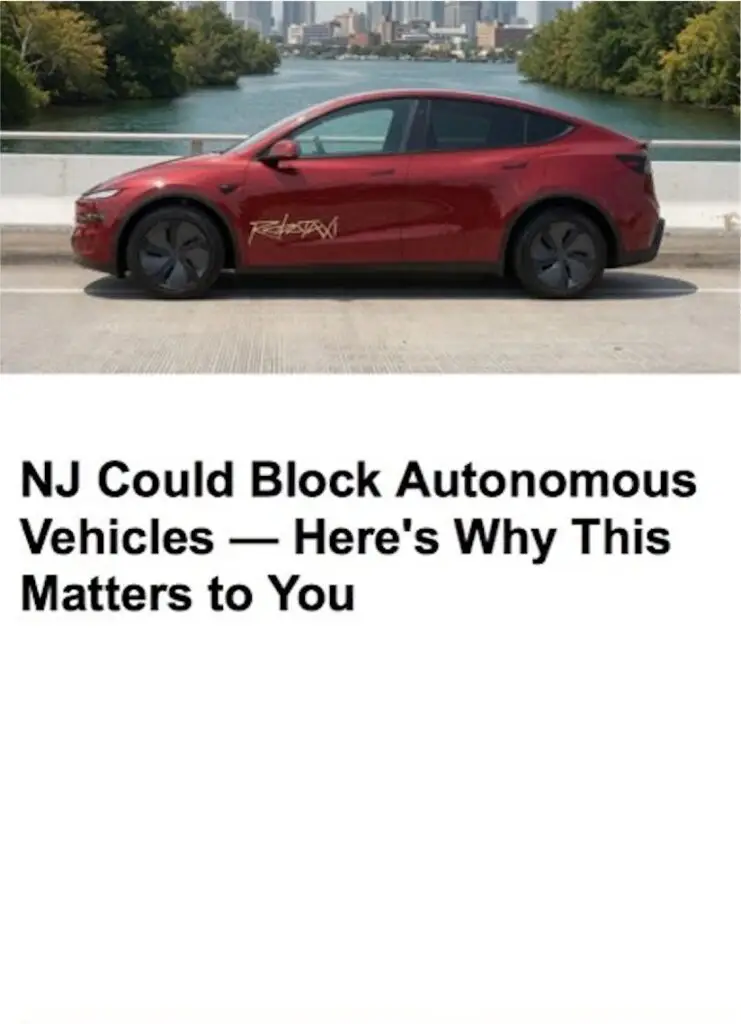
Table of Contents
A State-Level Fight With National Consequences
Tesla is warning New Jersey owners that proposed legislation in Trenton could make true driverless deployment effectively impossible. The wording matters because it frames the issue as more than a local regulatory fight. It is a test of how the United States will allow autonomous vehicles to move from supervised driver-assistance systems into real commercial deployment.
Autonomous vehicle policy in America is fragmented. Federal agencies set vehicle safety standards and investigate crashes, but states control licensing, road use, insurance requirements, local operating rules, and in many cases the practical permission to deploy. That means a company like Tesla can build a capable system and still face state-by-state limits on where it can operate.
New Jersey is not alone in asking hard questions. Lawmakers everywhere are being asked to judge a technology that moves faster than traditional vehicle regulation. They have to protect the public, respond to labor concerns, account for emergency services, and avoid letting unproven systems loose on public roads. Those are legitimate responsibilities.
The danger is when regulation becomes a ban wearing a safety label.
Why Tesla Is Mobilizing Owners
Tesla often uses its customer base as a political force. That is not accidental. Owners are not just buyers; they are local voters, taxpayers, and potential users of future robotaxi services. If proposed rules threaten driverless deployment, Tesla wants lawmakers to hear from people who see autonomous driving as a consumer benefit, not only from safety advocates, unions, insurers, or traditional transportation interests.
That strategy makes sense because autonomy will not be approved only through engineering. It will be approved through politics.
A state can slow deployment by requiring safety drivers indefinitely, limiting operating domains too narrowly, demanding permits that are difficult to obtain, or imposing reporting rules so burdensome that only a few companies can comply. Some requirements may be reasonable. Others may freeze the market before it starts.
Tesla’s argument is that New Jersey should not write rules so restrictive that a true driverless service remains illegal even if the technology becomes safe enough.
The Difference Between Safety Rules and Deployment Barriers
Good regulation should ask clear questions. What performance evidence is required? What crash reporting is mandatory? How are emergency responders trained? What happens when a vehicle blocks traffic? Who is liable? How does the company communicate with passengers? What operating conditions are allowed?
Those are real safety questions.
Bad regulation starts from a different place. It assumes driverless vehicles are unacceptable unless they behave like traditional vehicles with human drivers. That can create rules that sound cautious but block innovation by design.
The key distinction is whether a rule measures performance or preserves the old model. If an autonomous vehicle can demonstrate safe operation in a defined area, the rule should allow a pathway to deployment. If the rule requires a human driver forever, it is not regulating robotaxis. It is preventing them.
Why Driverless Rules Cannot Be One-Size-Fits-All
A delivery robot, a Tesla robotaxi, a Waymo vehicle, and a highway trucking system do not pose identical risks. They differ in speed, operating domain, sensor stack, supervision model, passenger use, and fallback procedures.
That is why state policy should avoid blanket restrictions. A performance-based system can set high bars without assuming all autonomy is the same. It can require companies to prove safety, disclose incidents, carry insurance, coordinate with local officials, and limit operations to approved conditions.
The public deserves that protection. But the public also deserves the upside: safer roads, more mobility for people who cannot drive, lower transportation cost, and less dependence on private car ownership in dense areas.
If New Jersey blocks deployment too broadly, it may protect residents from early risks while also delaying benefits that other states receive first.
The Bigger Question for Robotaxis
The New Jersey fight points to the next phase of the robotaxi race. The hardest obstacle may not be building vehicles that can drive. It may be building public and political trust fast enough for those vehicles to operate.
Tesla has a special challenge because its approach is different from companies that have spent years deploying geofenced robotaxis with lidar-heavy sensor suites. Tesla wants scale, software leverage, and a fleet already tied to its consumer vehicles. Regulators will want proof that this approach is safe enough.
That proof should be demanded. But the rules should also leave room for progress.
The right policy is not “trust Tesla.” It is not “ban driverless cars.” It is a transparent path: prove performance, report failures, define responsibility, and expand only when the evidence supports it.
New Jersey’s decision will matter beyond New Jersey. It will show whether states are ready to regulate autonomy as an emerging transportation system, or whether they will treat it as a threat to be contained.
Source
- Sawyer Merritt on X: https://x.com/SawyerMerritt/status/2066951648992165989
- NHTSA automated vehicles overview: https://www.nhtsa.gov/technology-innovation/automated-vehicles-safety
- Tesla Robotaxi: https://www.tesla.com/robotaxi