

 由 Sherry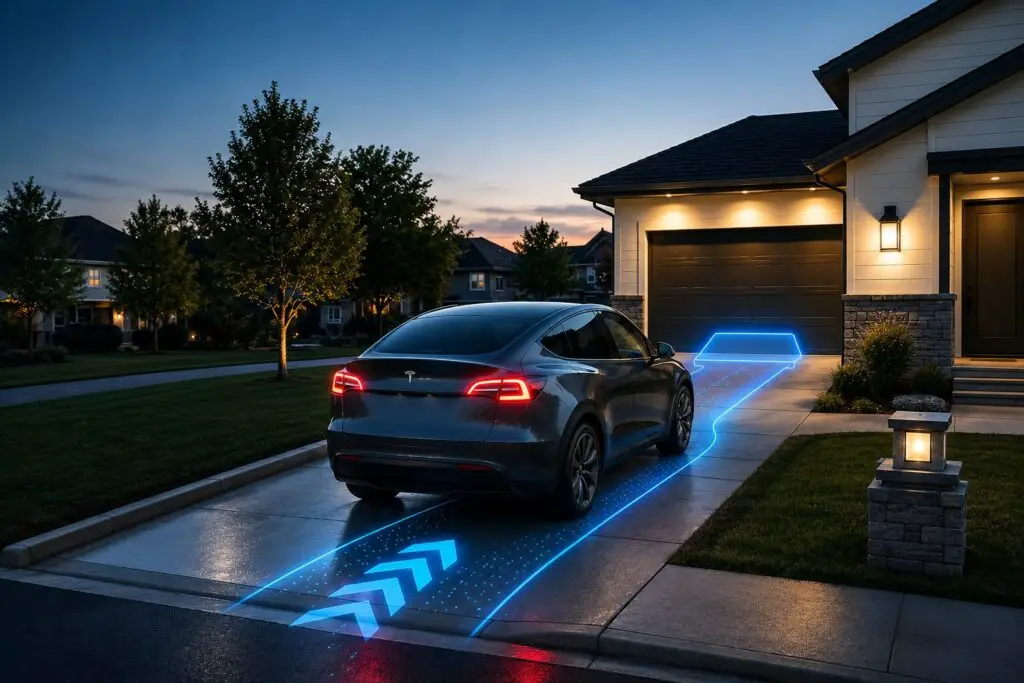
Table of Contents
The Drive Is Not Finished at the Address
Elon Musk says future versions of Tesla Full Self-Driving will remember a driver’s parking preferences, allowing the car to go to the right location at home, work, or school drop-off. He also says destination parking is now the biggest reason drivers intervene with FSD, while critical safety interventions are extremely rare.
The statement highlights a part of autonomy that gets less attention than intersections, highways, or unprotected turns. A navigation system can reach the correct street address and still fail the trip.
Consider a school. The correct arrival point may be a marked drop-off lane rather than the front entrance. At an office campus, the driver may want a specific garage level. At home, one person may park in the driveway while another uses the curb. A shopping center may have several entrances, loading areas, and parking zones sharing one address.
For a human, these details become habit. For an autonomous driving system, they are another prediction problem.
Why Parking Preferences Matter
Destination parking is difficult because maps usually describe places more broadly than people use them. A pin marks a destination, but it rarely captures the exact stopping behavior expected by the owner.
That creates awkward moments. FSD may reach the destination but choose the wrong side of a building, stop too early, enter an inconvenient driveway, or fail to select the preferred parking area. The driver then takes over, not because the vehicle made a dangerous mistake, but because it misunderstood intent.
This distinction matters when evaluating intervention data. Not every intervention is a safety failure. Some are corrections of preference, comfort, or convenience. A system can drive safely for miles and still need help with the final maneuver.
Tesla’s proposed solution is memory. If the vehicle learns repeated behavior, it can turn a generic map destination into a personal destination.
Memory Could Make FSD Feel Personal
Remembered parking preferences would move FSD from route execution toward behavioral personalization.
The car could learn that “home” means the left side of the driveway, that school drop-off uses the rear entrance on weekday mornings, or that the office requires a particular garage entrance. Over time, the system would need fewer corrections because it would understand not only where the driver is going, but how the driver completes the trip.
That is a powerful consumer feature because it reduces friction without requiring a dramatic autonomy breakthrough. The system does not need to solve every road in the world. It needs to remember the owner’s repeated destinations and behave correctly there.
It could also improve trust. Drivers are more likely to use automation when it behaves predictably in familiar places. A vehicle that repeatedly stops in the wrong location feels unintelligent, even if the drive was technically impressive. A vehicle that remembers the right spot feels attentive.
The challenge will be designing the memory system well. Drivers need an easy way to teach, confirm, edit, or delete preferences. Shared vehicles may need profiles. Temporary behavior should not become permanent. Tesla will also need to avoid learning illegal or unsafe stopping habits.
The Safety Claim Needs Context
Musk’s claim that critical safety interventions are extremely rare is encouraging, but it is not a complete safety metric.
Tesla does not publicly provide enough standardized detail for outsiders to separate every comfort intervention, navigation correction, parking takeover, and emergency intervention across the fleet. The company may have internal data showing that destination behavior dominates disengagements, but public evaluation still requires transparent definitions and exposure data.
What counts as critical? How many miles are driven? Which hardware and software versions are included? Does the measurement include near misses? How are driver-initiated takeovers classified?
Those questions do not invalidate the claim. They show why autonomy statistics are difficult to interpret without methodology.
Tesla’s official materials also remain clear that FSD is supervised. The enabled features require a fully attentive driver who is ready to take control. Remembering a parking preference would make the product more useful, but it would not change that legal or operational boundary.
The Last 50 Feet May Decide Adoption
Autonomy is often judged by the hardest visible moments: navigating traffic, turning across lanes, or reacting to unpredictable drivers. But mainstream adoption may depend just as much on small moments.
Does the vehicle stop where the passenger expects? Does it choose the right entrance? Does it understand the family routine? Does it park without turning the final minute of the trip into a negotiation?
These details determine whether people leave FSD engaged or take over out of habit.
If Tesla has reduced major driving interventions enough that destination parking is now the leading reason for takeover, that would represent a meaningful shift. The problem is no longer only “Can the car reach the destination?” It is “Can the car arrive like this driver would?”
That is a more mature autonomy problem. It is also a more human one.
The next major FSD improvement may not be a spectacular maneuver shared online. It may be the car quietly learning that at school, the correct destination is not the map pin. It is the third curb after the gate.
Source
- Elon Musk on X: https://x.com/elonmusk/status/2067377176287318326
- X trending discussion: https://x.com/i/trending/2067441190165991896
- Tesla Full Self-Driving (Supervised): https://www.tesla.com/support/full-self-driving-subscriptions