

 由 Sherry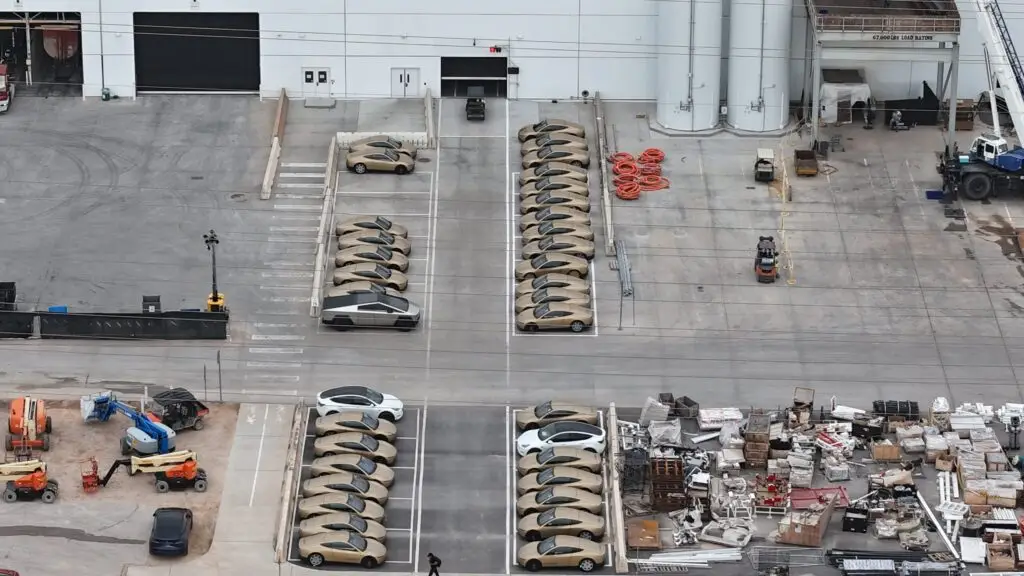
Table of Contents
The Factory Signal Is Getting Stronger
Drone footage from Giga Texas continues to show Cybercabs around the factory. Joe Tegtmeyer reported seeing vehicles lined up near the factory exit, some marked “Robotaxi,” and said Cybercabs were appearing among regular vehicle transportation staging areas. He also captured what appeared to be a steering-wheel-free Cybercab arriving and backing smoothly into a parking space.
These observations are not official production figures. Factory sightings can include prototypes, validation vehicles, training units, or pre-production builds. Still, they suggest Tesla is moving beyond a handful of event vehicles.
That matters because a robotaxi program needs physical scale before it can prove operational scale. Tesla needs vehicles for software testing, durability validation, remote-assistance procedures, cleaning systems, charging workflows, maintenance training, and eventually passenger service.
Building the car, however, may be the familiar part.
A Robotaxi Is More Than a Vehicle
Tesla has spent years becoming good at producing vehicles. Robotaxi service adds a different business.
A fleet has to be positioned where demand exists. Vehicles must be charged, cleaned, inspected, repaired, and redistributed. Lost property needs a process. Passenger emergencies need a response. A damaged vehicle must be removed quickly. Software faults require remote support. Charging stations need enough capacity to avoid creating queues of idle cars.
Traditional transit and taxi operators already understand many of these problems. Autonomous fleets add new ones because there is no driver inside the vehicle to notice a dirty seat, hear a strange mechanical noise, help a passenger, or decide when the car should leave service.
The vehicle may be autonomous. The business surrounding it is intensely human.
Why Fleet Operations Become the Bottleneck
Tegtmeyer pointed to fleet management and scaling as a possible limit on deployment speed. That is an important observation because autonomy discussions often focus almost entirely on driving software.
Even if Tesla’s system becomes technically capable of driverless operation, service expansion will depend on local infrastructure. A city needs enough vehicles, charging sites, service capacity, remote support staff, insurance coverage, and regulatory coordination.
Utilization is critical. A robotaxi earns money only when it carries passengers. Time spent charging, cleaning, waiting in the wrong neighborhood, or undergoing repair reduces the economic advantage of removing the driver.
This is why purpose-built hardware matters. The Cybercab is reportedly lightweight, efficient, and equipped with a relatively small battery. Those choices may reduce energy and manufacturing costs. But low vehicle cost cannot compensate for poor fleet utilization.
A cheap robotaxi sitting in a depot is still an unproductive asset.
Autonomous Parking Is an Operational Feature
The reported sighting of a Cybercab backing into a parking space may look like a small demonstration. In a fleet context, it is more meaningful.
Depots require precise parking. Vehicles may need to align with charging equipment, cleaning bays, inspection stations, or staging lanes. If Cybercabs can move through these environments without human drivers, Tesla can automate more of the fleet workflow.
This connects with Tesla’s wider interest in destination parking and remembered stopping preferences. Autonomy is not complete when the vehicle reaches a street address. It must place itself correctly for the next task.
For a consumer, that means the right driveway or school entrance. For a fleet, it means the correct charger, service bay, or passenger pickup zone.
The final few meters can affect the entire operation.
The Next Tesla Ramp Is Invisible
Tesla’s manufacturing ramps are highly visible. Drone photographers can count cars, watch factory expansions, and identify new staging patterns. The operational ramp will be harder to see.
It will include software dashboards, remote-support systems, depot procedures, cleaning standards, incident protocols, charging schedules, and city-by-city regulatory work. None of that looks as dramatic as rows of Cybercabs outside Giga Texas, but it may determine the program’s success.
Tesla has some advantages. It controls the vehicle, software, charging ecosystem, and customer app. It has experience managing service centers and mobile technicians. Its Supercharger knowledge could help with energy planning.
But ride-hailing operations are different from selling cars. Demand changes by hour. Passengers create unpredictable problems. Local rules vary. A system that works in one city may require a different operating model in another.
The Cybercab sightings show that Tesla is building the hardware foundation. The next question is whether the company is also building the operational organization that turns vehicles into reliable transportation.
Robotaxi scale will not be measured only by how many Cybercabs leave the factory. It will be measured by how many remain clean, charged, correctly positioned, and available when a passenger opens the app.
Source
- Joe Tegtmeyer on X: https://x.com/JoeTegtmeyer/status/2067266265459089530
- Tesla Robotaxi: https://www.tesla.com/robotaxi