

 由 Sherry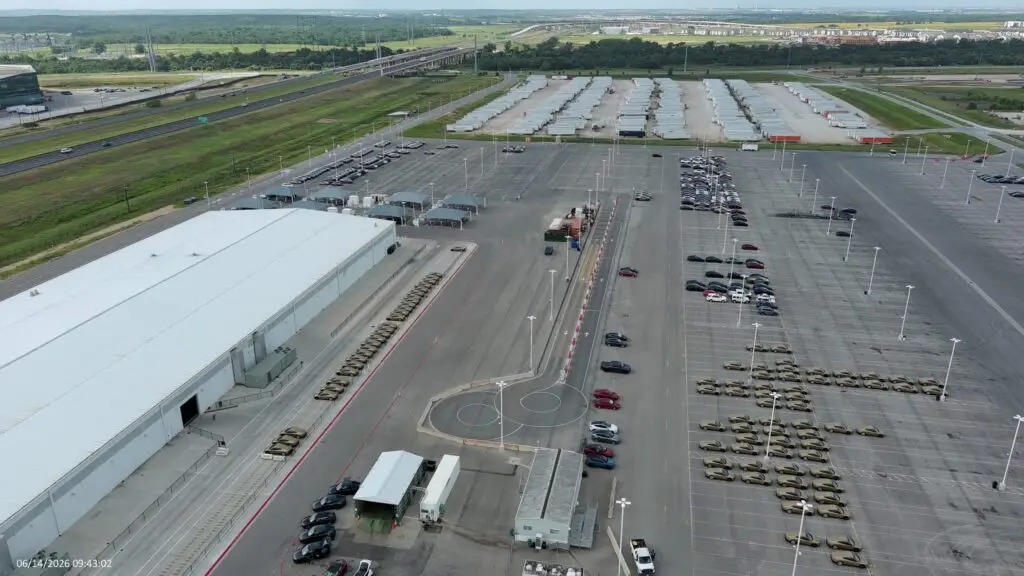
Table of Contents
Why Factory Sightings Matter
Dalton Brewer reported that around 150 Cybercabs had been spotted at Giga Texas, calling it a sign that production is ramping. The post quoted Airwave Dynamics’ flyover of the Giga Texas test track and west side of the factory complex.
Factory sightings are not official production numbers. They should be treated carefully. But they can still be useful signals, especially for a vehicle like Cybercab. A purpose-built robotaxi does not simply need a few display prototypes. It needs a fleet: vehicles for validation, software testing, crash testing, durability cycles, regulatory work, service procedures, and eventually commercial deployment.
If dozens or hundreds of Cybercabs are appearing around Giga Texas, it suggests Tesla is no longer treating the vehicle as a showpiece. It is building units that can support a broader testing and launch process.
Production Ramp or Validation Fleet
The key question is whether the sightings represent customer-ready production or pre-commercial validation.
With Cybercab, that distinction is especially important. Tesla can build many vehicles before it is ready to deploy them as unsupervised robotaxis. The hardware ramp and the autonomy ramp are related, but they are not the same.
A fleet of vehicles at Giga Texas could support software iteration. It could also support ride-hailing pilots, mapping checks, safety validation, maintenance training, or regulatory demonstrations. If the vehicle lacks steering wheel and pedals, Tesla must prove not only that it can build the car, but that it can operate it safely within approved domains.
That means the number of vehicles matters less than how Tesla uses them.
The Test Track Signal
The Airwave Dynamics flyover is notable because it focuses on the Giga Texas test track. For a normal consumer vehicle, test tracks are used for handling, braking, durability, and validation. For Cybercab, the test environment may be even more important.
Tesla needs repeated controlled testing of perception, stopping behavior, pickup and drop-off logic, obstacle handling, low-speed maneuvers, and edge cases. A purpose-built robotaxi may spend much of its life in dense urban driving, where the hard problems are not top speed but judgment.
Test tracks cannot prove real-world autonomy alone. They can, however, support repeatability. Engineers can create the same scenario again and again, test new software builds, and validate hardware changes. That kind of process is essential before wider public deployment.
Cybercab Needs More Than Assembly
The Cybercab hardware specs being discussed point to a lightweight, efficient vehicle: roughly 48 kWh battery capacity, front-wheel drive, about 219 horsepower, and a curb weight around 3,113 to 3,118 pounds. Those numbers make sense for a robotaxi if Tesla can keep operating cost low.
But the hardware is only one part of the system.
A robotaxi fleet also needs charging strategy, cleaning, remote support, insurance, customer pickup logic, incident response, depot operations, and maintenance. If Tesla is building Cybercabs in meaningful numbers, the company also has to build the operational machine around them.
That is why Giga Texas sightings are interesting. A ramp at the factory could be the visible part of a much larger invisible ramp: service systems, fleet software, regulatory preparation, and real-world operating processes.
What to Watch Next
The next signals will matter more than the sightings themselves.
First, watch whether Cybercabs begin appearing in consistent public-road testing outside factory grounds. Second, watch for regulatory filings or exemptions related to vehicles without conventional controls. Third, watch whether Tesla expands robotaxi operations beyond limited areas. Fourth, watch whether the Cybercab fleet appears tied to production validation or revenue service.
If Tesla is only building a few dozen units for testing, the story is early. If the company is preparing hundreds or thousands of units for deployment, the robotaxi story becomes much more serious.
The Giga Texas images do not prove that Cybercab is ready. But they do suggest Tesla is assembling the fleet-level reality behind the robotaxi narrative.
For a company that has talked about autonomy for years, that physical evidence matters. Software may decide whether Cybercab succeeds, but hardware on the ground is how the promise becomes testable.