

 由 Sherry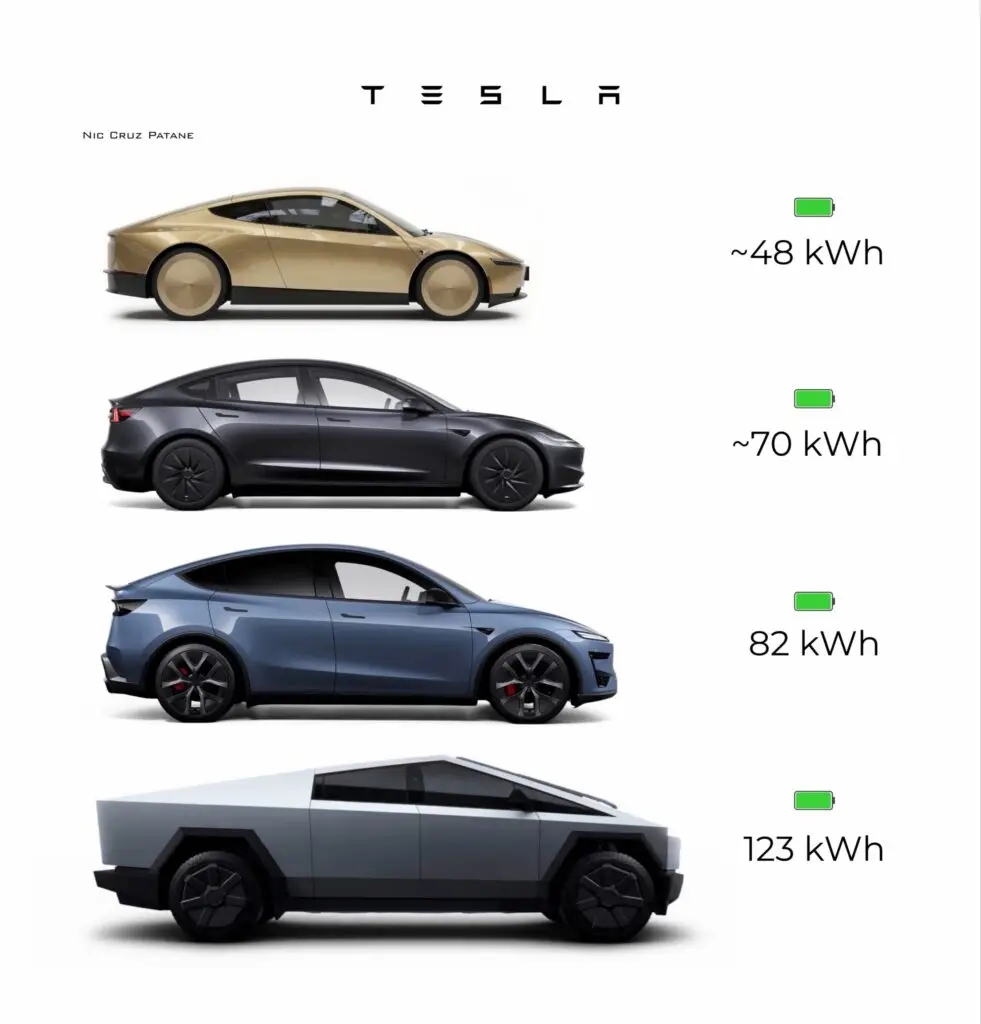
Table of Contents
Two Very Different Vehicles, One Cell Strategy
Nic Cruz Patane highlighted current Tesla production battery capacities and noted that both Cybertruck and Cybercab use 4680 cells. That pairing is worth paying attention to because the two vehicles could not be more different.
Cybertruck is a large, heavy, expensive electric pickup built around durability, towing, presence, and extreme design. Cybercab is a small, purpose-built autonomous vehicle aimed at low-cost mobility. One is a consumer truck. The other is a fleet economics machine.
The shared 4680 connection suggests Tesla is not treating the cell format as a one-off Cybertruck experiment. It is trying to make 4680 part of a broader manufacturing platform.
That matters because Tesla’s long-term advantage is not only software. It is the ability to connect battery production, vehicle structure, powertrain packaging, and manufacturing simplification into one system.
Why 4680 Matters Beyond Chemistry
The 4680 cell has often been discussed as if it were only a battery chemistry story. In reality, the format is also a manufacturing story.
Tesla introduced the 4680 idea as part of a broader plan to reduce battery cost, simplify pack construction, and support structural battery designs. A larger cylindrical cell can reduce the number of cells needed in a pack compared with smaller formats. In theory, that can simplify assembly, improve packaging, and reduce cost if production yields and performance are good enough.
The phrase “if production yields are good enough” is doing a lot of work. 4680 has been difficult. Tesla has spent years ramping, refining, and defending the program. Critics have argued that the promised cost breakthroughs were slower than expected. Supporters argue that battery manufacturing is hard, and that Tesla is building expertise competitors cannot easily copy.
Cybercab gives the 4680 program a new test.
Cybertruck Proved the Hard Part
Cybertruck was always a difficult first major 4680 vehicle. It is heavy, high-profile, and demanding. Its battery pack has to support range, towing, high load, thermal performance, and customer expectations for a premium product.
That made Cybertruck a harsh proving ground. Any weakness in energy density, charging, cost, or pack complexity becomes visible quickly. A truck buyer expects capability, and a Cybertruck buyer expects Tesla-level spectacle.
Cybercab is different. It does not need to tow. It does not need performance theater. It needs to be cheap, efficient, durable, and repeatable. That may be a more natural fit for a mature 4680 manufacturing process.
If Tesla can use 4680 cells in a roughly 48 kWh Cybercab pack, the cell strategy becomes less about powering extreme vehicles and more about making autonomous mobility affordable.
Cybercab Needs a Different Kind of Battery Success
For Cybercab, the most important battery metric may not be maximum range. It may be lifetime cost per mile.
A robotaxi battery has to survive high utilization. It may charge often, operate many hours per day, and accumulate miles quickly. Replacement cost matters. Degradation matters. Thermal consistency matters. Repairability and pack cost matter.
The Cybercab’s reported battery capacity is modest, which makes sense if Tesla is aiming for a vehicle that can be produced cheaply and operated efficiently. A smaller pack means less material per unit. If range remains high enough for daily fleet operation, Tesla can avoid overbuilding the vehicle.
That is where 4680 could become strategically important. The cell does not have to win every consumer comparison. It has to help Tesla build a robotaxi cheaply enough, repeatedly enough, and reliably enough.
The Risk Is Scale, Not Theory
The 4680 thesis is attractive, but the risk remains scale. Tesla has to produce enough cells at the right cost and quality to support both Cybertruck and Cybercab. If 4680 output remains constrained, the cell could become a bottleneck rather than an advantage.
That is the central question. Is 4680 now mature enough to support multiple Tesla product lines, or is Tesla still working through the hard middle of the ramp?
Cybercab may answer that question faster than any investor slide. A robotaxi vehicle only makes sense if Tesla can build it in large numbers at low cost. If 4680 enables that, the program becomes a key part of Tesla’s autonomy economics.
The fact that Cybertruck and Cybercab both use 4680 cells does not prove Tesla has solved battery manufacturing. But it does show the company is still betting on vertical integration as the foundation of its next act.
For Tesla, the cell is not just a component. It is part of the business model.