

 由 Sherry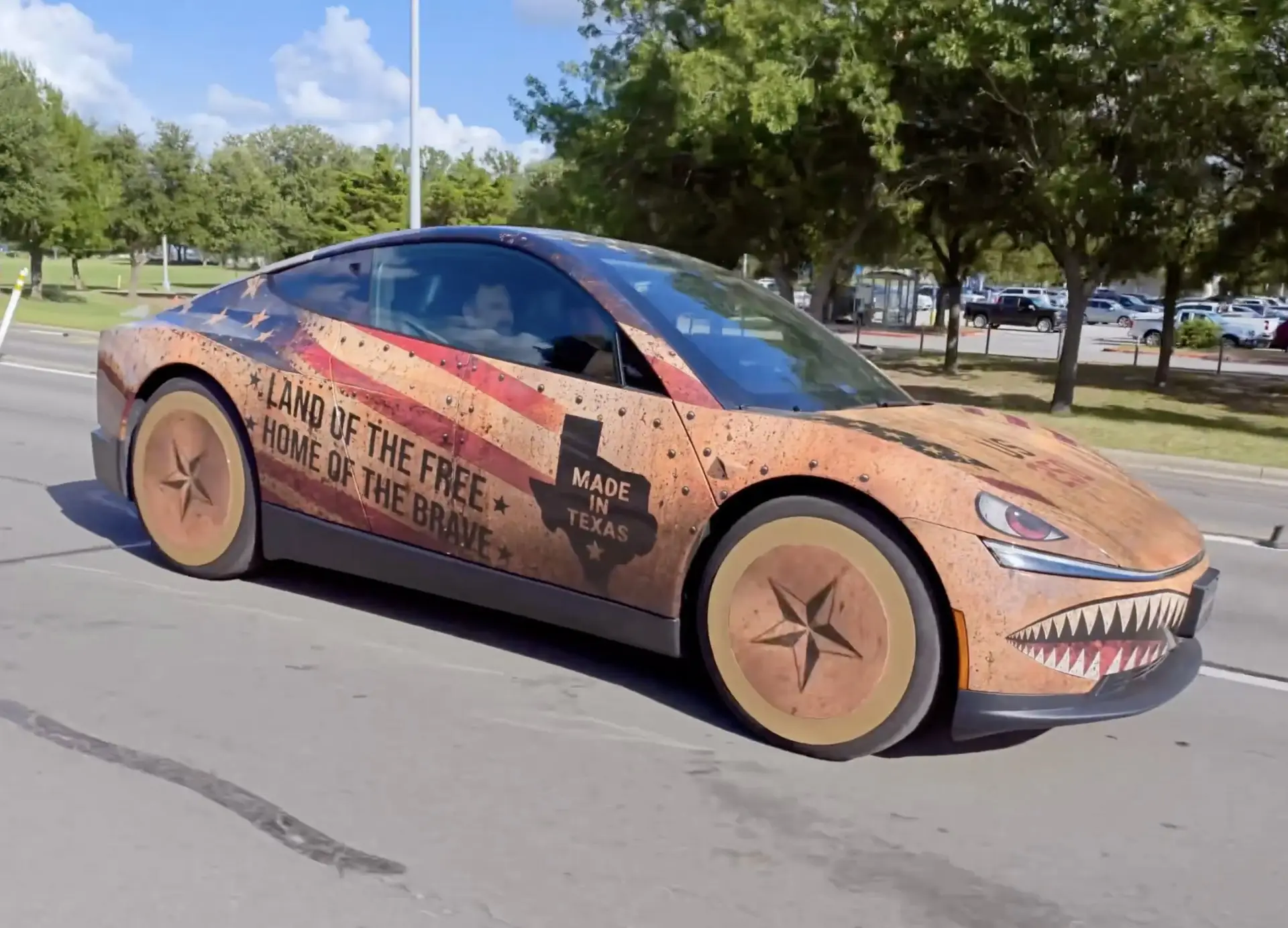
Table of Contents
What changes when the controls disappear
A steering wheel tells other road users that someone is driving. Remove the wheel and pedals, and that familiar cue disappears.
Videos shared this week show a production-form Cybercab testing on Austin roads without manual controls. A safety monitor was reportedly seated on the passenger side, although the vehicle offered no conventional way for that person to take over. Tesla also displayed another Cybercab for America’s 250th anniversary with ‘Made in Texas’ graphics and a cartoon face.
One appearance is an engineering test and the other is branding, but both expose the same challenge. Passengers, police, emergency crews, cyclists and pedestrians need to understand a vehicle with no visible driver.
Why Tesla gave Cybercab a friendly face
Painted eyes and a mouth do nothing for Cybercab’s perception software. They do make unfamiliar machinery look less severe. People already read cars socially by looking at the driver, wheel position, speed and road position.
A driverless car removes the person who normally provides those signals. Designers may use lights, displays, movement or simply consistent behavior to communicate intent. The decorative face is not a real communication system, but it points to the desire for confirmation that the vehicle has noticed someone.
The patriotic wrap has another purpose. ‘Made in Texas’ connects Cybercab with a familiar story about local manufacturing instead of presenting it only as an AI experiment. The Austin reference and anniversary theme make the vehicle easier to place culturally.
Public roads demand stronger evidence
Factory footage proves that a vehicle exists. Testing in traffic asks whether it can operate safely on roads designed around human drivers.
Without manual controls, a safety driver cannot grab the wheel or press a pedal. Intervention has to come from remote support, a commanded stop or the car’s own minimal-risk response. Tesla needs to explain what happens around construction, police directions, lost connectivity or a disabled vehicle blocking an intersection.
A steering wheel is not automatically safer. Human drivers cause many crashes, while automated systems can watch continuously without fatigue. Removing manual controls does, however, place the full driving task on the vehicle within its approved operating area.
That claim needs operating data rather than confident-looking demonstrations.
Trust depends on operating details
Tesla has published first-responder documents explaining how crews can identify and stabilize Cybercab, reach passengers and contact Robotaxi Support. Texas also has an automated-vehicle program that gives regulators and police a process for dealing with commercial deployments.
These procedures become more important as the fleet grows. Passengers need a reliable help channel, and responders need access and shutdown instructions. Cities need incident reports. Other road users need the car to behave consistently enough that they can anticipate its movement.
Tesla should also describe the passenger-seat safety monitor precisely. The public needs to know whether that person can stop the car, whether remote operators are available and what conditions define the test area. Vague descriptions invite both exaggerated praise and unnecessary fear.
Familiarity is part of deployment
Cybercab will ultimately be judged by incidents, service reliability and passenger experience. Before then, people have to become accustomed to seeing a two-seat vehicle with no visible driver moving through regular traffic.
The road test and the celebratory wrap address different parts of that process. One tests production hardware and autonomy. The other makes the car visible and easier to discuss. Neither can establish trust by itself.
Tesla is skilled at turning product development into a public event. Cybercab leaves less room for showmanship. A friendly face can attract interest, but acceptance will depend on the car yielding correctly, stopping safely and giving officials useful information when something fails.
Without a driver, every movement becomes a signal. Cybercab does not need to look ordinary, but it does need to behave predictably enough that passengers and other road users stop treating every encounter as an experiment.
Source
- Sawyer Merritt post: https://x.com/SawyerMerritt/status/2072110796113351132
- Adan Guajardo post: https://x.com/AdanGuajardo/status/2072086711056699590
- Tesla post: https://x.com/Tesla/status/2071810353156194719
- Tesla Robotaxi: https://www.tesla.com/robotaxi
- Tesla Robotaxi information for first responders: https://www.tesla.com/firstresponders/robotaxi
- Texas DMV Automated Vehicles Regulatory Program: https://www.txdmv.gov/AVprogram
- TechCrunch, Tesla Starts Testing Cybercab Without Pedals or a Steering Wheel in Austin: https://techcrunch.com/2026/06/30/tesla-starts-testing-cybercab-without-pedals-or-a-steering-wheel-in-austin/