

 由 Sherry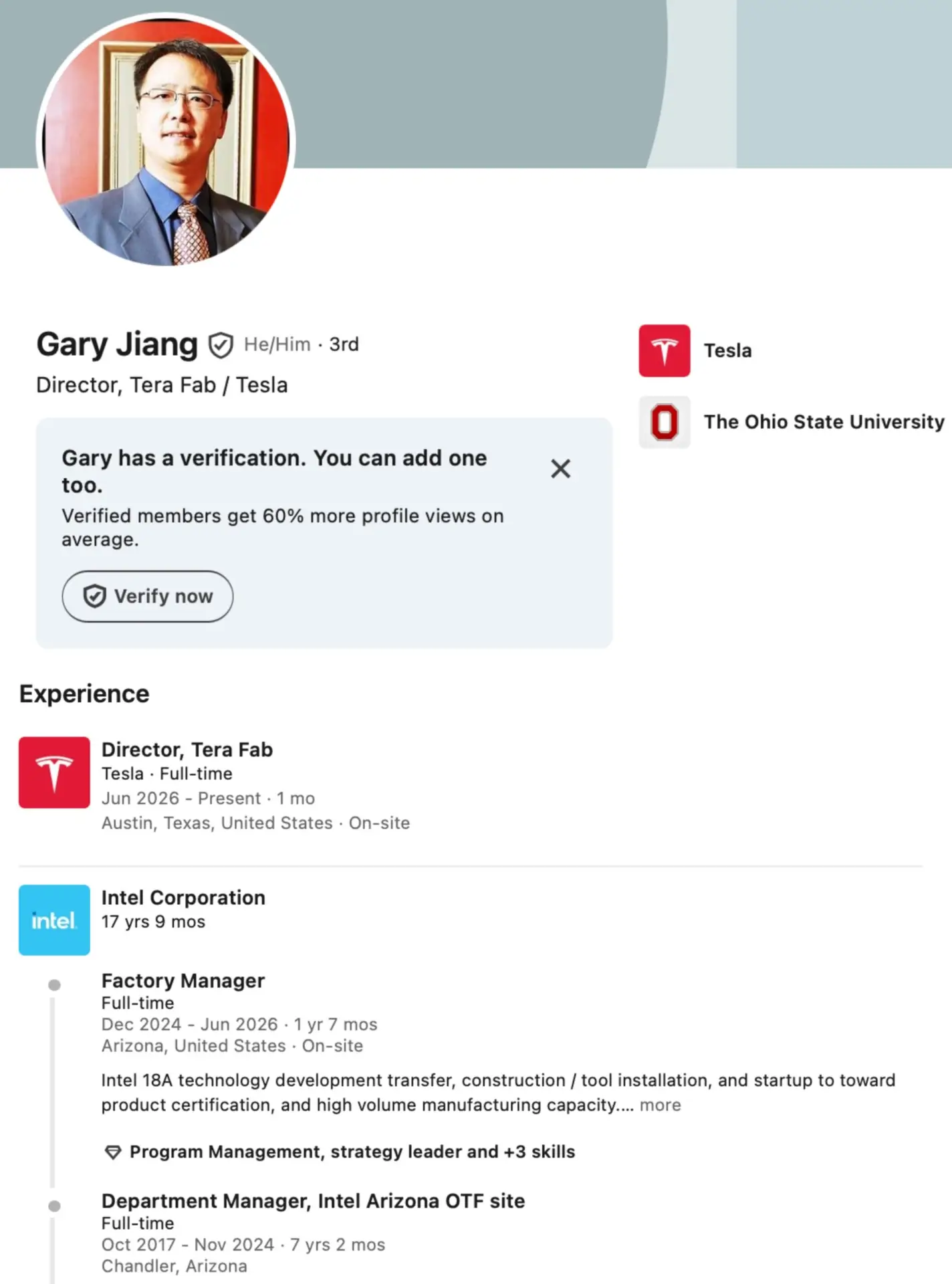
Table of Contents
One hire carries unusual responsibility
Tesla has attached enormous targets to Terafab, including high chip volumes and an integrated operation covering logic, memory, packaging and testing. A smaller development may say more about the project’s current stage. Gary Jiang, who spent nearly 18 years in semiconductor manufacturing at Intel, has reportedly joined Tesla as director of Tera Fab in Austin.
One executive cannot build a semiconductor plant. The appointment does show that Tesla is moving into work that requires process owners, yield engineers and contamination controls. Equipment installation, supplier qualification and thousands of routine production decisions must follow.
Tesla is therefore starting to recruit for execution, rather than only describing the chips it hopes to make.
Why Tesla wants more control over chips
Computing now reaches far beyond Tesla’s infotainment systems. Its vehicles use custom inference hardware, and future autonomous-driving systems will require more capable processors. Optimus would add another computer to every robot, while training these products consumes large amounts of data-center hardware.
Tesla may be treating chips much as it once treated batteries. The company invested in cell design, manufacturing equipment and factories when battery supply threatened its plans. Terafab applies the same approach to silicon by bringing more production capacity within the group.
Outside foundries and packaging companies serve many customers, so their available capacity and schedules can affect Tesla’s product plans. More direct control could help Tesla coordinate chip and product design, secure capacity for its own programs and shorten development feedback.
It would not make Tesla independent of the semiconductor supply chain. Advanced chipmakers still rely on specialized tools, materials, design software and suppliers around the world. Terafab would change those dependencies, not remove them.
A fab is different from a Gigafactory
Tesla knows how to build cars, batteries and energy products. Chip fabrication requires another kind of manufacturing discipline. Vehicle plants handle large assemblies and visible production steps. Advanced fabs work at microscopic scales, where tiny variations can ruin a large share of output.
Processing the first wafer is not the difficult benchmark. The plant must consistently produce working dies that meet performance targets and can be packaged at an acceptable cost. Raising yield takes statistical control, stable equipment and experience accumulated over many production runs.
Experienced leadership matters because buying tools is only the beginning. A fab needs teams that can interpret millions of process signals without losing control of quality. Tesla’s habit of rapid iteration may help, but it has to operate within very tight process limits.
Intel experience helps, but offers no shortcut
Intel has said it is participating in Terafab and pointed to its chip design, fabrication and packaging capabilities. A leader trained in that environment could help convert Tesla’s targets into plans for process technology, tool delivery, qualification and yield ramping.
No single hire brings an entire institution’s knowledge with them. Jiang’s arrival is better viewed as a starting point for a larger team. Useful signs of progress would include more process and facilities hires, equipment orders, permits, supplier deals and a credible path from pilot wafers to volume output.
Tesla, SpaceX, xAI and Intel will also need clear responsibilities. Their combined demand and expertise could support the project, but their priorities will differ. A vehicle chip, a robot processor, an AI training system and space hardware do not necessarily need the same design or production schedule.
Tesla now has to build the organization
For now, Terafab is less a scale story than a recruiting and management challenge. Tesla must attract semiconductor specialists, give them enough authority and fit strict process control into the company’s compressed schedules.
The project will advance through repeatable production, not one successful wafer. If Tesla eventually makes useful quantities of advanced chips, the result will depend on a team capable of producing the next wafer with the same quality as the first.
Source
- Sawyer Merritt post: https://x.com/SawyerMerritt/status/2072034501337706544
- EV: Tesla Taps Intel Veteran Gary Jiang to Lead Terafab Chip Fab: https://eletric-vehicles.com/tesla/tesla-taps-intel-veteran-gary-jiang-to-lead-terafab-chip-fab/
- Tom’s Hardware: Intel Joins Elon Musk’s Terafab Project: https://www.tomshardware.com/tech-industry/semiconductors/intel-joins-elon-musks-terafab-project-intel-is-proud-to-join-the-terafab-project-with-spacex-xai-and-tesla-to-help-refactor-silicon-fab-technology
- Tom’s Hardware: Terafab Plans to Use Intel’s 14A Process: https://www.tomshardware.com/tech-industry/semiconductors/elon-musk-says-terafab-will-use-intels-14a-process-technology-to-make-ai-chips-spacex-will-be-responsible-for-high-volume-chip-manufacturing-in-liekly-intel-tech-licensing-deal