

 由 Sherry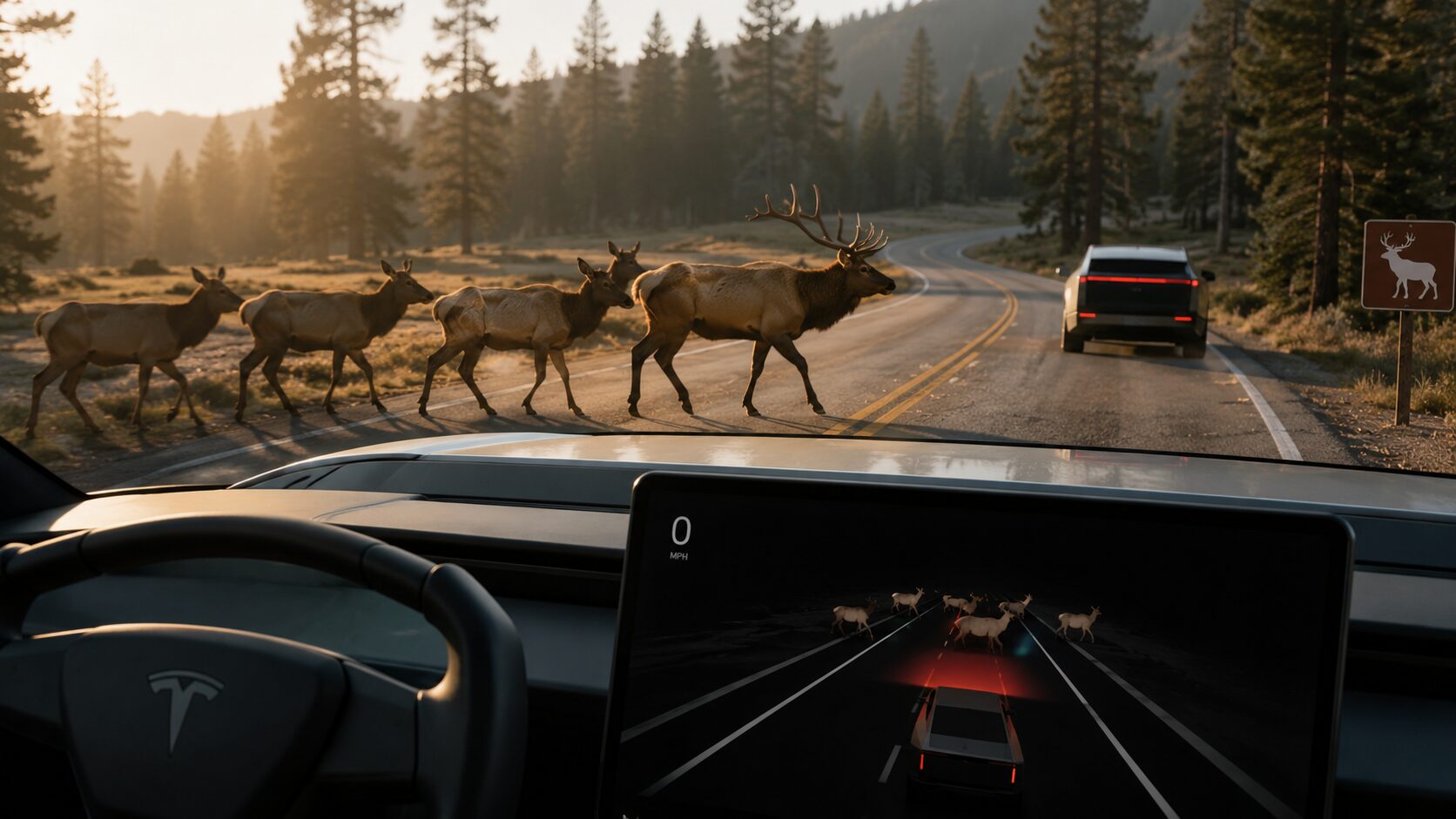
Table of Contents
Why the Yellowstone clip gets attention
A Tesla owner was filming the scenery while Full Self-Driving (Supervised) guided a Cybertruck through Yellowstone. When a herd of elk entered the road, the truck appears in the posted video to stop smoothly and wait for the animals to pass.
The clip is persuasive because it looks like ordinary good driving, not a staged test. There is no foam target or marked lane. A group of large animals enters the road in a park where wildlife often controls traffic, and the vehicle chooses to wait.
That is close to what drivers want from an assistance system. They are less interested in the neural network design than whether the car sees danger early, brakes calmly and avoids surprising the vehicle behind it.
Animals are difficult to predict
Roads are organized around human conventions such as lanes, signs and signals. Wildlife follows none of them. An elk can stop, turn back or follow another animal without warning. Vegetation, darkness and other animals may hide part of its body, while a herd creates overlapping moving shapes.
Detection is only the first step. The car must estimate distance and motion, decide whether the animals are entering its path, account for surrounding traffic and choose how hard to brake. A late stop risks a severe crash, while unnecessary or harsh braking can cause a rear-end collision.
Yellowstone makes cautious driving especially appropriate. The National Park Service tells visitors to allow extra time, obey a maximum 45 mph limit unless signs say otherwise and expect wildlife delays. Drivers should move slowly, remain patient and stay in the vehicle when animals occupy the road.
A video shows capability, not reliability
The clip shows that the system handled one encounter. It does not tell us how often it would succeed at other speeds or in different light, weather and road geometry. Animal size and approach angle also matter. Social media rarely gives the full sample, and owners do not post failed interventions as consistently as successful ones.
That does not make the video worthless. Road footage can reveal behavior that a specification cannot, and the smooth braking and patient wait are worth observing. The problem starts when one good result is treated as statistical proof.
Tesla publishes fleet-level collision comparisons for FSD (Supervised) and explains when it counts a crash as occurring with the feature engaged. Those figures offer more context than one clip, but independent comparisons remain difficult because road type, vehicle age, drivers and reporting methods vary. Exposure data would make both fleet claims and viral videos easier to interpret.
The driver is still part of the system
The Cybertruck manual is direct: FSD (Supervised) requires an attentive driver who can take over at any time. Tesla says external cameras build a model of the surroundings and help the system react to pedestrians, cyclists and vehicles. It also warns that blocked cameras, weather and other conditions can reduce performance.
The Yellowstone drive should therefore be viewed as a combined human and software operation. The car handled the braking, while the driver remained responsible for watching the road. Looking at the scenery is understandable. Assuming the car will always recognize an animal is not.
Supervision is more than legal wording. The driver’s attention is the fallback when the system misreads a scene, conditions change quickly or the vehicle behaves unexpectedly.
What stronger evidence would include
More viral clips alone will not answer the reliability question. Useful data would separate encounters by animal type, speed, visibility and result. It would record whether the car or driver began braking and compare intervention rates across software versions. Controlled testing could repeat difficult scenes, while fleet data would show behavior outside the test track.
Response quality matters too. The car should slow early enough to avoid startling the animals, leave a sensible stopping distance and wait until the full herd clears. Following drivers also need enough warning to react safely.
The clip deserves attention because the Cybertruck appears to handle a messy road situation calmly. It proves that the system managed this encounter. Safety claims need a much larger record showing that the same behavior returns when the animal, road or weather changes.
Source
- Teslaconomics Yellowstone video post: https://x.com/Teslaconomics/status/2071426453749760199
- Tesla Cybertruck Full Self-Driving (Supervised) manual: https://www.tesla.com/ownersmanual/cybertruck/en_us/GUID-2CB60804-9CEA-4F4B-8B04-09B991368DC5.html
- Tesla Full Self-Driving Vehicle Safety Report: https://www.tesla.com/VehicleSafetyReport?redirect=no
- Yellowstone National Park safety guidance: https://www.nps.gov/yell/planyourvisit/safety.htm