

 由 Sherry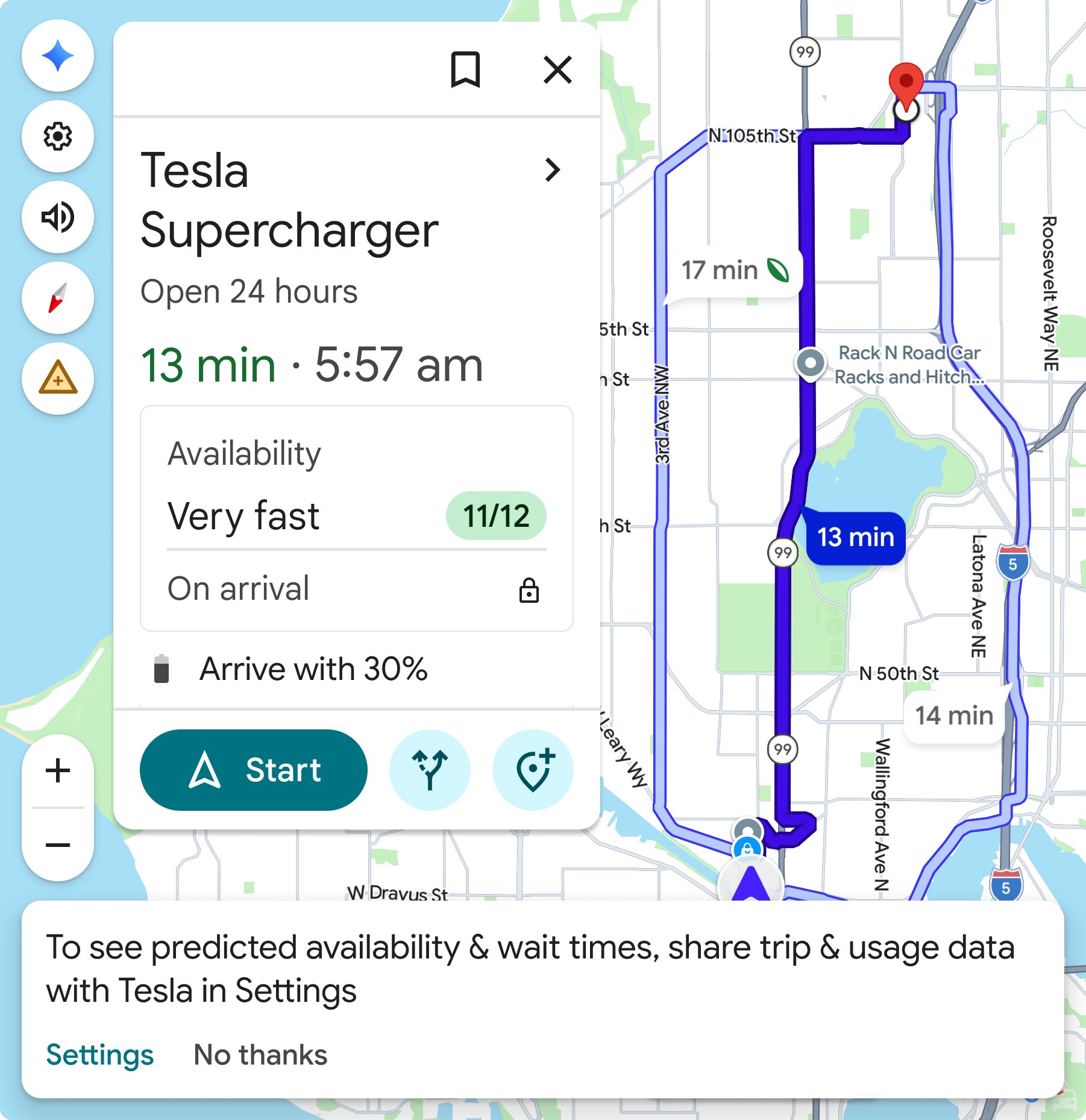
Table of Contents
The next charging upgrade is information
Tesla Charging announced that forecasted stall availability is rolling out globally to eligible EVs with Google Maps built in. The feature lets drivers see predicted Supercharger availability ahead of time and asks eligible users to opt in so predictions improve for everyone.
That may sound like a small navigation feature, but it goes after a common EV pain point: uncertainty. Drivers ask whether a charger exists and whether it will be open when they arrive.
Charging has always been physical infrastructure. It is now also becoming a prediction system.
This kind of feature rarely gets the attention that faster charging hardware gets, but it may affect daily confidence more often. A driver planning a trip wants more than maximum kilowatts. They want the stop to be predictable.
Why forecasting beats a static map
A static charger map tells you where a station is. A live availability feed tells you what is happening now. A forecast tries to tell you what the station may look like when you arrive.
That distinction matters because charging is time-dependent. A site with ten open stalls at 1:00 p.m. may be full at 1:20 p.m. if several road-trippers arrive. A crowded site may clear by the time another driver reaches it.
Forecasting can reduce anxiety and spread demand across the network. If navigation sees that one station is likely to be busy, it can send drivers toward a better option before a line forms.
That helps the network operator too. Better distribution can reduce peak congestion without building new stalls right away. Software cannot replace physical expansion, but it can help existing infrastructure work harder.
Opening Superchargers Changes The Challenge
Tesla’s charging network is no longer only for Tesla owners. As more non-Tesla EVs gain access through NACS and adapters, the network has to handle more vehicle types, charging curves, navigation systems, payment flows, and expectations.
That makes prediction more useful and more difficult. Tesla needs to understand station status and likely arrival patterns across a wider mix of vehicles.
Google Maps integration helps because many EV drivers already use it as their default navigation layer. If charging predictions reach drivers outside Tesla’s own app ecosystem, Supercharger routing becomes more useful across the EV market.
Data Sharing Becomes Infrastructure
The opt-in language matters. Better predictions depend on data: destination, charging intent, route timing, and possibly state-of-charge signals depending on the integration. That creates a trade-off between utility and privacy.
Drivers will share data if the benefit is obvious. A prediction that saves 15 minutes at a crowded charger is obvious. A vague promise to improve the network is weaker.
This is an area where Tesla has an advantage. The company already has deep operational data from its own fleet and Supercharger network. Extending predictive availability through Google Maps could make that intelligence useful to more drivers.
What Drivers Actually Want
Most EV drivers do not want to think like infrastructure planners. They want to know where to stop, how long it will take, and whether the charger will work.
Forecasted availability moves charging closer to that expectation. It treats charging like traffic, weather, or restaurant wait times: not perfectly knowable, but predictable enough to make a better decision.
The effect could be larger than the feature sounds. EV adoption depends on trust. When drivers reach stations without surprise queues, trust grows. When navigation avoids a bad stop before it happens, the car feels easier to live with.
The next EV infrastructure race will include more stalls, but it will also depend on making the network easier to plan around.
For non-Tesla EV drivers, that could matter even more. As more brands plug into Superchargers, Tesla’s network becomes part of the wider EV experience. Prediction tools can make that transition less chaotic.
Source
- Tesla Charging X post on forecasted Supercharger stall availability: https://x.com/TeslaCharging/status/2070241084366901442
- Tesla Supercharger page: https://www.tesla.com/supercharger
- Google built-in for cars: https://built-in.google/cars/
- Tesla app support page: https://www.tesla.com/support/tesla-app
- U.S. Department of Energy EV charging basics: https://www.energy.gov/energysaver/electric-vehicles