

 由 Sherry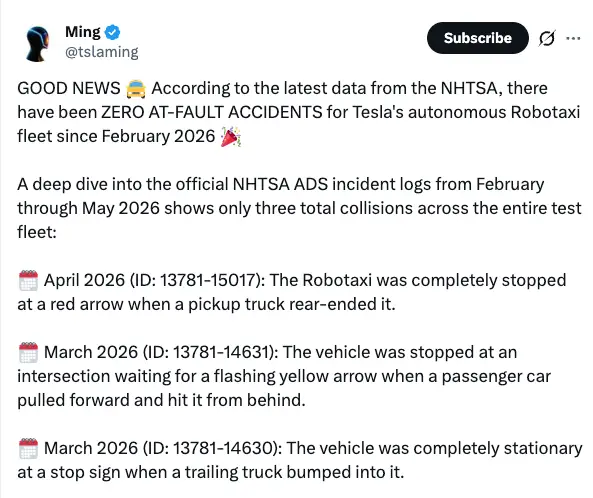
Table of Contents
The Claim Getting Attention
Ming posted a detailed claim based on NHTSA ADS incident logs: since February 2026, Tesla’s autonomous Robotaxi fleet has had zero at-fault accidents. The post identifies three total collisions from March through May, each involving a Tesla robotaxi that was reportedly stopped when another vehicle struck it from behind.
The examples are specific. One April incident involved a Robotaxi stopped at a red arrow when a pickup rear-ended it. Two March incidents involved a vehicle stopped at an intersection or stop sign when a following vehicle bumped it.
If those descriptions are accurate, they matter. A vehicle that is safely stopped and gets rear-ended is very different from an autonomous system making a bad decision.
But safety data in autonomy needs careful reading.
Why Stationary Rear-End Crashes Matter
Rear-end collisions into a stopped vehicle often say more about the trailing human driver than the stopped vehicle. If the robotaxi was at 0 mph, obeying traffic control, and waiting appropriately, then the collision may not indicate a system fault.
That is important for Tesla because robotaxi critics often look for evidence that the system behaves unpredictably. A cluster of incidents where the vehicle was stationary could support the argument that the fleet is not creating the crash scenario.
It also highlights one of autonomy’s potential strengths. A robotaxi does not get impatient, text while driving, or roll forward because it is distracted. If the system can stop correctly and wait, that part of the driving task may be safer than many human behaviors.
Still, “not at fault” is not the same as “proven safer than humans.”
What the Data Does Not Tell Us
The biggest missing number is exposure. How many miles did the fleet drive? In what locations? Under what conditions? With what level of safety monitoring? How many disengagements occurred? How many near misses? How many operational interventions?
Without mileage and context, three crashes can look impressive or meaningless depending on the denominator.
This is the problem with many robotaxi safety arguments. Supporters point to individual incidents where the autonomous vehicle behaved correctly. Critics point to videos where the vehicle behaved strangely. Neither side alone gives a full safety case.
A proper safety comparison needs miles, road types, time of day, weather, crash severity, operating domain, vehicle mix, reporting thresholds, and human benchmarks.
NHTSA’s Standing General Order crash reports are useful, but they are not the whole story. They capture reportable incidents under defined criteria. They do not automatically reveal every operational challenge.
Why Transparency Is the Next Battleground
Tesla’s robotaxi strategy will increasingly be judged by transparency. Waymo, for example, has published detailed safety analyses comparing rider-only crash rates with human benchmarks. Whether one agrees with every method, that kind of disclosure gives the public and regulators a framework for evaluation.
Tesla has historically preferred product progress, user videos, and selective data points over detailed safety reporting. That may not be enough as robotaxi deployment expands.
If Tesla can show not only that individual crashes were not its fault, but that fleet-level crash rates are lower across meaningful categories, the robotaxi case gets stronger. If it cannot, critics will argue that supporters are overreading limited incident logs.
The next phase of the autonomy race is not only technical. It is statistical and public-facing.
The Right Way to Read the Milestone
The reported NHTSA incidents are encouraging for Tesla if they accurately show stationary vehicles being hit by human drivers. They suggest that, at least in those cases, the autonomous system was not the initiator of the crash.
That is good news. It is not the final verdict.
Tesla still needs to prove safety across scale, not anecdotes. It needs to show how the system performs over large mileage, in complex environments, and against transparent benchmarks. It also needs to explain how its camera-based approach handles edge cases that have challenged every autonomy company.
The milestone is therefore best described as positive but incomplete.
For Tesla, no at-fault incidents in a limited set of reported crashes is a useful signal. For the public, the bigger question is whether Tesla can turn useful signals into a convincing safety case.
Robotaxi trust will not be built by one post or one log entry. It will be built by repeatable evidence.