

 由 Sherry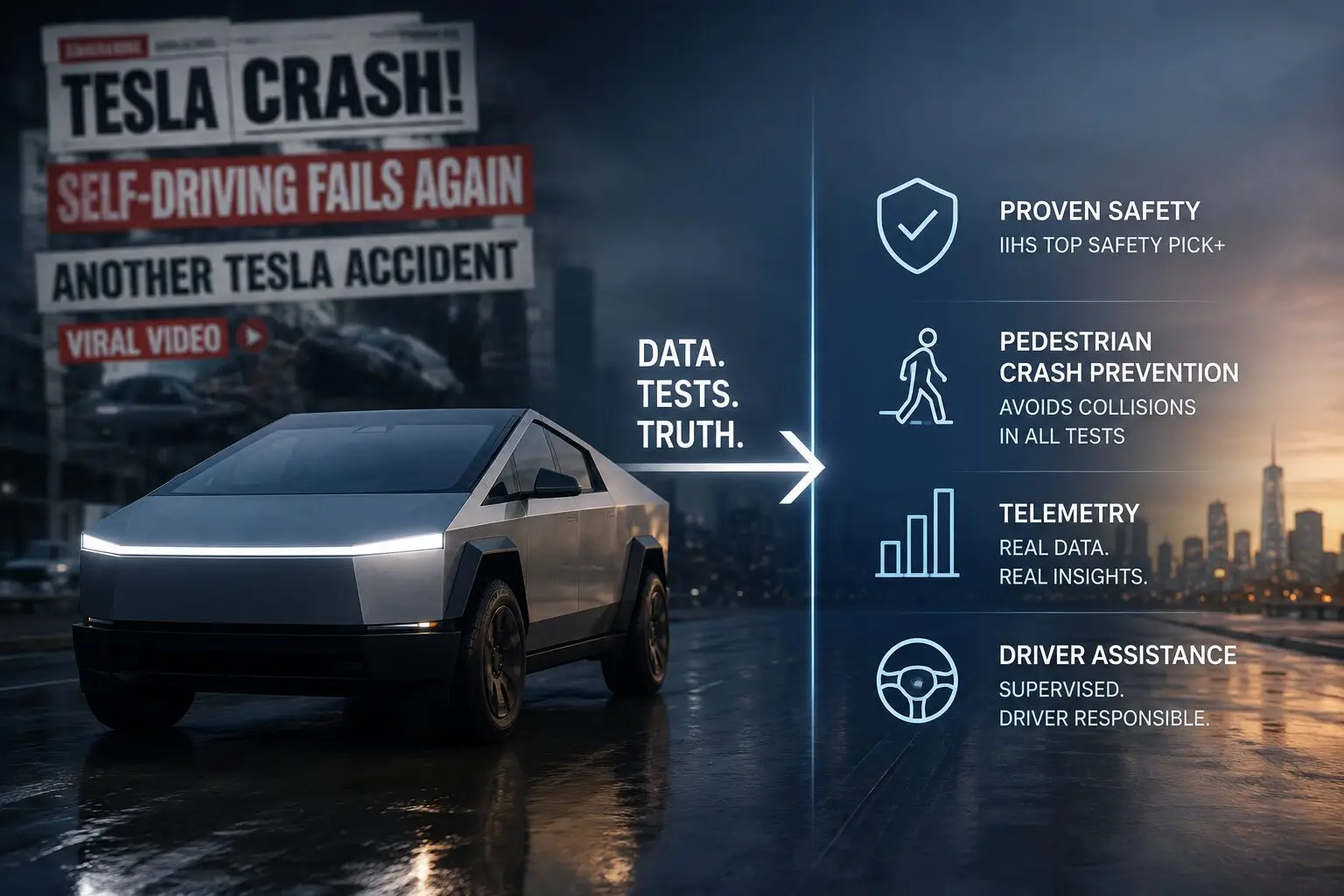
Table of Contents
Two safety stories, one problem
Tesla safety discussions are usually loud, but two recent posts show why they are also becoming more dependent on data. Tesla said the Cybertruck avoided every collision in IIHS pedestrian front crash prevention tests across daytime, nighttime, and different-angle scenarios, and that it was the only pickup to earn Top Safety Pick+ in 2026. Separately, a post from Stock Mom argued that a New York Post report wrongly framed a crash as “full Autopilot,” while Tesla reportedly said the driver had overridden Autopilot by pressing the accelerator fully.
These are different stories, but they point to the same problem. Tesla safety debates often squeeze complicated facts into simple narratives. One side wants every positive test to prove Tesla is safest. The other wants every crash headline to prove Tesla technology is reckless. Neither shortcut is good enough.
Modern vehicle safety includes crash structure, active safety, driver behavior, software limits, sensor performance, and post-crash evidence. The public conversation still tends to mash those categories together.
Cybertruck’s IIHS result gives Tesla a measured win
The Cybertruck has been polarizing since launch. Its stainless-steel body, size, sharp visual identity, and unusual engineering make it easy to praise and easy to criticize. That is why the IIHS result matters. It gives Tesla a structured safety point instead of another social-media argument.
Pedestrian front crash prevention matters especially for large vehicles. Pickups and SUVs can pose serious risks to pedestrians because of their mass, height, and front-end shape. If Cybertruck performs well in tests designed to measure pedestrian avoidance, that is a real result.
The word “test” still matters. IIHS protocols are not the same as every real-world scenario. A strong result does not mean a vehicle can avoid all pedestrian collisions. It means the vehicle performed well under defined, repeatable conditions. Safety debates need more of that kind of evidence.
For Tesla, the result also pushes back on the assumption that Cybertruck’s unusual design must mean poor safety performance. Safety should be judged by evidence, not by how a vehicle looks. A truck can look intimidating and still perform well in certain active-safety tests.
Crash narratives move faster than corrections
The second story is messier. According to the Stock Mom post, Tesla said a driver overrode Autopilot by fully pressing the accelerator, with telemetry reportedly showing that input continued even after impact. The post criticized media framing that suggested the crash was caused by “full Autopilot.”
The specific crash details should be handled carefully unless primary records are public. But the larger issue is familiar. A crash involving a Tesla can become a technology story before investigators, telemetry, or official reports are fully understood. Early wording matters. “Autopilot,” “Full Self-Driving,” “driverless,” “self-driving,” and “driver assistance” are often blurred, even though they describe different levels of responsibility.
That confusion damages public understanding. If a driver overrides a system, that is different from the system failing on its own. If a supervised feature was active, that is different from a driverless robotaxi. If a driver-assistance feature was not engaged, it should not be treated as if it was.
Why telemetry matters
Tesla vehicles collect extensive data, and that data can be critical after crashes. Accelerator input, braking, steering, system engagement, speed, warnings, and impact timing can all change how an event is understood.
Telemetry is not a public-relations magic wand. Companies should not win every argument simply by saying they have data. Regulators, insurers, courts, and investigators need reliable access when needed. But telemetry can help stop one of the worst habits in the safety debate: deciding fault from a headline.
As vehicles become more software-defined, post-incident analysis will look more like aviation-style review. What was the system doing? What was the human doing? What warnings were issued? What intervention happened? What did the vehicle detect? Those questions are more useful than arguing whether a brand is good or bad.
The public needs cleaner categories
Tesla also has a communication burden. The company uses names like Autopilot and Full Self-Driving Supervised while telling drivers they must stay attentive and responsible. Critics argue the names encourage overtrust. Supporters argue the warnings are clear and the technology is improving quickly.
Both points can be true. Tesla can have real active-safety achievements and still need precise public communication. Media outlets can scrutinize Tesla without using sloppy terminology. Regulators can investigate crashes without deciding the conclusion before the data is reviewed.
The Cybertruck IIHS result and the Autopilot crash correction belong in the same conversation because they show two sides of safety evidence. Controlled tests can show capability. Telemetry can clarify what happened in an incident. Neither should be replaced by instinct.
The next phase of vehicle safety will require more discipline from automakers, journalists, regulators, and fans. Tesla’s products are too visible, and the stakes are too high, for vague language to carry the debate. Safety is not a slogan. It is a record of performance, limits, failures, and improvements over time.
Source
- Tesla X post on Cybertruck IIHS pedestrian front crash prevention and Top Safety Pick+: https://x.com/Tesla/status/2069588778063438255
- Stock Mom X post on Autopilot crash correction and driver accelerator override claim: https://x.com/stockmom/status/2069582657277604152
- IIHS vehicle ratings page for Tesla Cybertruck: https://www.iihs.org/ratings/vehicle/tesla/cybertruck-crew-cab-pickup/2026
- Tesla Autopilot support page: https://www.tesla.com/support/autopilot
- NHTSA automated vehicles safety page: https://www.nhtsa.gov/vehicle-safety/automated-vehicles-safety