

 由 Sherry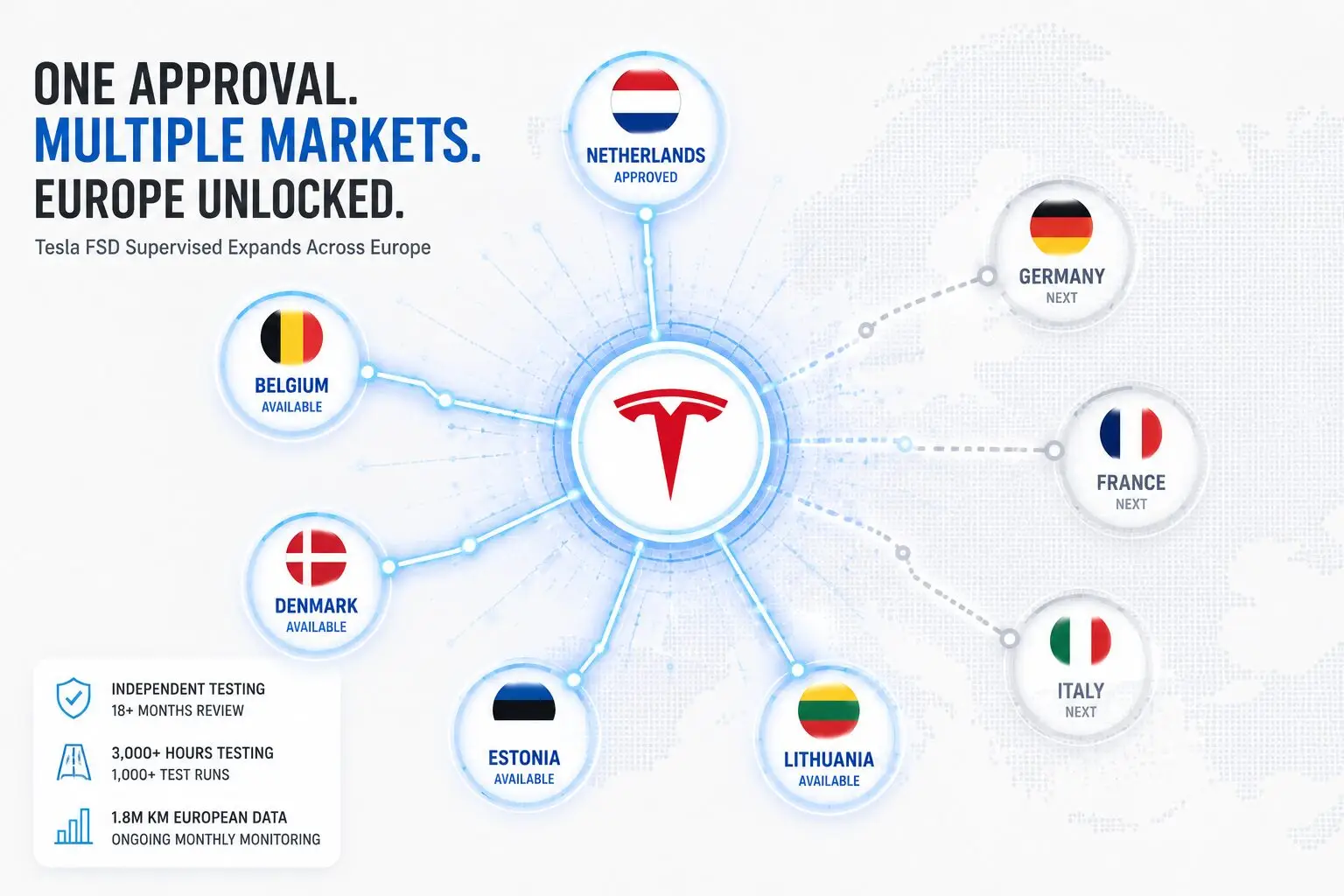
Table of Contents
The Netherlands Opened More Than One Market
Tesla Full Self-Driving Supervised is now listed as available in the Netherlands, Lithuania, Estonia, Denmark, and Belgium. That expansion occurred quickly, and it illustrates a powerful feature of European vehicle regulation: an approval granted through one national authority can influence access elsewhere through common rules and mutual recognition.
The Netherlands therefore did more than approve a driver-assistance feature for Dutch roads. It gave Tesla a regulatory foothold.
This matters because Europe has historically been difficult for Tesla’s FSD strategy. European roads are diverse, city layouts are old and complex, regulations are strict, and individual countries have different political attitudes toward automation.
Instead of winning every market from zero, Tesla can use the RDW approval as a reference point.
Mutual Recognition Changes Tesla’s Expansion Math
Vehicle type approval is designed to reduce duplication inside Europe. If a component or vehicle meets applicable European requirements through an authorized approval body, other markets can recognize that decision rather than repeating the entire process.
For Tesla, this creates leverage. The company spent more than 18 months working through the Dutch process, including 3,000 hours of independent RDW testing, more than 1,000 test runs, and analysis of 1.8 million European kilometers.
That investment becomes more valuable if it supports entry into several countries.
The result is a different rollout strategy from the United States, where state laws and local operating rules can create separate deployment battles. In Europe, the challenge is demanding at the approval stage, but a successful approval can travel.
That does not mean every country must accept every feature immediately. National authorities still influence road rules, enforcement, consumer communication, and political acceptance. But the Dutch certificate gives Tesla a stronger starting position.
Fast Expansion Creates a Transparency Problem
The same mechanism that helps Tesla expand also fuels criticism.
Some safety researchers and officials want more visibility into the data behind the approval. Tesla’s safety statistics have been criticized when comparisons use different vehicle populations, older fleets, or broad assumptions. The RDW says it independently validated Tesla’s methods and conducted extensive testing, but commercial confidentiality prevents every underlying detail from becoming public.
That creates an uncomfortable gap.
The public is asked to trust the regulator’s process, while the most technical evidence may remain confidential. This is normal in vehicle type approval, where manufacturers submit proprietary information. But FSD attracts more scrutiny than a conventional component because it controls multiple driving tasks and changes through software.
RDW has responded by increasing Tesla’s reporting requirement from annual to monthly and continuing in-use supervision. That is a strong measure, but public trust will still depend on how much performance information can be disclosed.
Europe Is Still Not One Autonomous Market
The rollout remains uneven.
Smaller countries and markets connected closely to the Dutch approval have moved faster. Larger markets such as Germany, France, and Italy may take a more cautious political approach. Sweden has shown interest in testing while also raising concerns about local conditions such as winter weather and driving behavior.
This unevenness reflects Europe’s dual character. It has common regulatory structures, but national governments still respond to local roads, voters, safety organizations, and industry interests.
Tesla will therefore need two strategies at once. The technical strategy is to use common approval rules. The political strategy is to demonstrate the system locally, respond to criticism, and show that FSD Supervised fits each market’s expectations.
That is why European expansion will likely happen in waves rather than through one continent-wide switch.
The Dutch Approval Is a Strategic Asset
The most important thing Tesla gained in the Netherlands may not be immediate subscription revenue. It gained a regulatory case study.
The company can point to independent testing, European driving data, strict driver monitoring, monthly reporting, and millions of kilometers of post-approval use. Each additional market adds more local data, which can support applications elsewhere.
This creates a feedback loop. Approval enables driving. Driving creates data. Data supports monitoring and future approvals. Wider availability creates more customer exposure and political familiarity.
The system remains supervised, and Tesla explicitly says it does not make the vehicle autonomous. That distinction should remain central. But supervised FSD can still reshape the European ADAS market by raising expectations for what driver assistance should do.
The Dutch approval shows that Tesla’s European challenge is no longer simply whether regulators will allow FSD. The challenge is how quickly one approval can become a network of approvals without losing public confidence.
In Europe, the autonomy race may be won not only with better neural networks, but with better regulatory compounding.
Source
- iamtobi on X: https://x.com/iamtobi/status/2067262882060849414
- Ming on X: https://x.com/tslaming/status/2067267120183091590
- Rustavi on X: https://x.com/Rustavi/status/2067236992484540768
- RDW explanation: https://www.rdw.nl/en/news/2026/explanation-of-the-type-approval-of-fsd-supervised
- Tesla FSD availability: https://www.tesla.com/support/full-self-driving-subscriptions