

 由 Sherry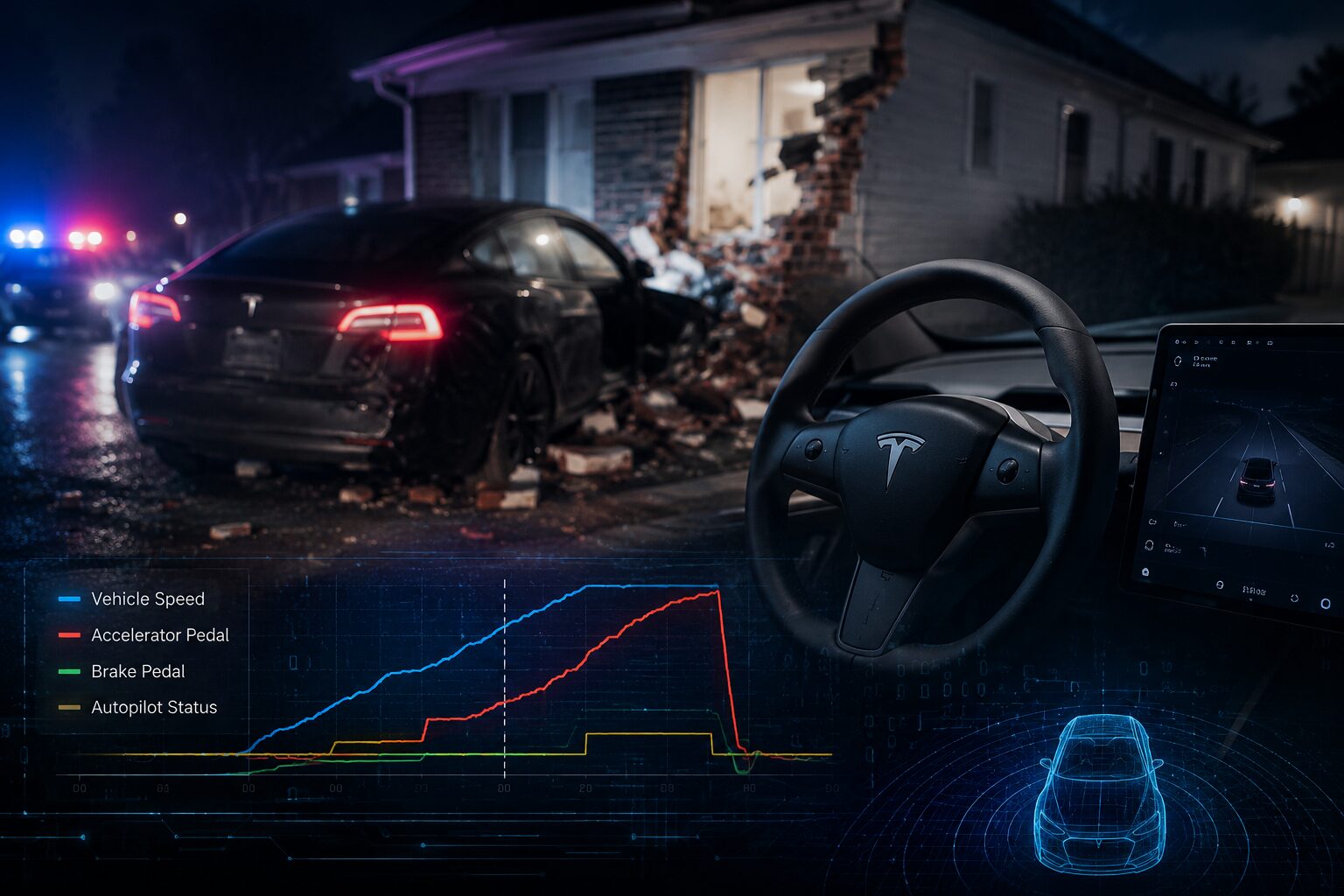
Table of Contents
A criminal charge changes the question
A Texas driver faces a manslaughter charge after a June 19 crash in Katy, where a Tesla Model 3 struck a house and killed a woman inside. The charge is an allegation, and the evidence will be tested in court.
The probable-cause account also raises a wider question about supervised driving systems. Investigators allege that FSD (Supervised) was active before the driver pressed the accelerator approaching a turn. They say pedal pressure increased for about six seconds until reaching 100%, the car accelerated to roughly 73 mph and the brake was not pressed before impact.
The case is therefore concerned with what happened after the driver allegedly overrode the system, rather than simply whether FSD was active.
That distinction is important. Driver-assistance status is only one part of the sequence that determines control.
An override transfers control
Tesla’s supervised system allows steering, braking and accelerator input from the driver. That intervention is necessary because the person behind the wheel remains responsible and must be able to act immediately.
Accelerator override creates a mixed-control state. Drivers may press the pedal because they think the car is entering traffic too slowly or hesitating. The software may continue steering while the person commands more speed.
That interaction can feel straightforward in normal use and become difficult to describe after a crash. Saying that FSD was active does not identify who requested the speed, whether the system warned the driver or how long the manual input continued.
The allegations draw that boundary through recorded pedal input. If pressure rose steadily to full travel, prosecutors may describe it as a sustained command rather than a brief accidental touch. The defense can challenge that interpretation, but both sides have more than a driver’s recollection to examine.
Vehicle logs can reconstruct the final seconds
Modern vehicles record large amounts of data. Tesla’s Model 3 documentation says the event data recorder may store crash-related information including speed, accelerator position, brake position and steering data.
Investigators can align those signals with video and driver-assistance status. They can examine whether braking began, whether steering moved away from the hazard and whether the car recorded a mechanical fault.
The logs are not automatically conclusive. Investigators must collect and synchronize the data correctly, and qualified witnesses must explain it. Accelerator percentage records what a sensor detected, not why the person pressed the pedal.
Even with those limits, digital records can narrow the possible explanations. Traditional crash analysis relied heavily on tire marks, damage and witnesses. Connected vehicles may preserve the driver’s inputs in far greater detail.
Search history provides context, not proof
Investigators also allege that the driver’s phone contained earlier searches complaining that FSD was too timid or insufficiently aggressive in city traffic. Prosecutors may use those searches to argue that the driver had considered accelerating through the system’s hesitation.
The searches cannot establish what happened on their own. People look up complaints and troubleshooting information for many reasons, and a query made weeks earlier cannot replace evidence from the crash.
Its value depends on the rest of the record. Prosecutors may combine the searches with sustained accelerator input, no braking and no recorded mechanical failure. Defense lawyers can argue that the searches were general and have been given too much weight.
Public discussion needs the same caution. Search history can sound persuasive while remaining circumstantial. The synchronized record of the car and driver’s actions is likely to carry more weight.
The driver remains responsible
FSD (Supervised) is a driver-assistance feature. Tesla requires an attentive driver who is prepared to intervene, regardless of what the product name may suggest.
This case could clarify the difference between software operation and a human command for speed. The fact that FSD was engaged does not by itself establish the cause of the crash.
The court will decide the criminal charge. The narrower point is already clear: in a supervised system, a manual override returns control to the driver and may leave a detailed record of that intervention.
Source
- Sawyer Merritt post, Texas Model 3 manslaughter charge and affidavit excerpt:https://x.com/SawyerMerritt/status/2072838875563589973
- Simon Unleashed post, State of Texas v. Michael David Butler charging-document summary:https://x.com/SimonSaysKnow/status/2072825730916917553
- ABC13 Houston, Tesla Driver Arrested in Connection With Manslaughter After Fatal House Crash:https://abc13.com/post/tesla-driver-arrested-connection-manslaughter-crash-left-woman-dead-home-sheriff-says/19432699/
- Tesla Model 3 Owner’s Manual, Event Data Recorder:https://www.tesla.com/ownersmanual/model3/en_cn/GUID-2E8E5E0B-DAA8-40B8-9804-45F5960538DF.html
- Tesla Model 3 Owner’s Manual, Full Self-Driving Supervised:https://www.tesla.com/ownersmanual/model3/en_us/Owners_Manual.pdf