

 由 Sherry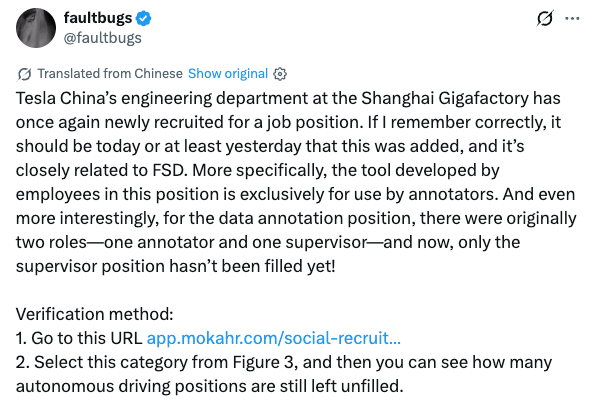
Table of Contents
A small hiring signal with a large backstory
A post from faultbugs on X pointed to a newly added Tesla China engineering role at Gigafactory Shanghai that appears closely related to FSD. The post says the employee would develop tools for data labelers, and notes that a previous data-labeling role may have changed, leaving a supervisory position still listed.
This is not the kind of headline that moves casual readers. It is not a product launch, regulatory approval, or public demo. But for Tesla’s China FSD ambitions, it may be exactly the kind of quiet signal worth watching.
Autonomy is not only a vehicle feature. It is a data system. Before software can handle complex roads, teams need to collect, sort, label, validate, and feed driving scenarios into training and evaluation. A role focused on tools for labelers points to the infrastructure behind that work.
Data labeling is not back-office work
People sometimes talk about AI training as if raw data automatically becomes intelligence. It does not. Labeled data is often where the system learns what matters: lane markings, traffic participants, signs, unusual vehicle behavior, pedestrians, construction zones, road edges, and ambiguous interactions.
Good labeling tools improve speed, consistency, and quality. Poor tools create noise. In autonomous driving, noise is expensive because small misunderstandings can affect model behavior. If a system repeatedly misclassifies a local road pattern, the issue may start before the car ever sees that scenario in deployment.
That is why an engineering role around labeling tools is more strategic than it sounds. It suggests Tesla may be strengthening the human-and-software pipeline that turns Chinese driving data into useful model improvement.
China is a different driving environment
China is not only another market for Tesla. It is one of the world’s most important EV markets and one of the most complex urban driving environments. Dense cities, scooters, delivery vehicles, aggressive lane changes, mixed traffic, construction, unusual intersections, and local road signs can all create edge cases.
A supervised driving system trained and validated mainly outside China cannot assume every local pattern will map cleanly. Even if the core model is strong, localization matters. The system has to understand local signs, road markings, traffic flow, and driver behavior well enough to be useful and trustworthy.
The local competitive pressure is also intense. Chinese automakers and technology firms are moving quickly on advanced driver assistance. Brands such as Huawei-backed systems, XPeng, Li Auto, NIO, and others have trained buyers to expect visible progress in navigation-assisted driving. Tesla’s global brand remains powerful, but China will judge the product locally.
Localization is also a regulatory question
FSD in China is not only about technical readiness. It also depends on data rules, mapping requirements, cybersecurity expectations, and regulatory approval. China has strict controls around data handling, and advanced driving systems can involve sensitive road and location information.
That makes local infrastructure important. If Tesla can build more capability inside China, including data workflows and labeling support, it may be better positioned to satisfy local requirements while improving local performance.
A job listing does not prove an imminent FSD launch. It is a clue, not a confirmation. But it can show direction. A company preparing only a marketing rollout does not need deep data-labeling tooling. A company preparing a localized autonomy pipeline does.
What to watch next
The next useful signals will likely be practical rather than dramatic: official Tesla China language around FSD capability, local regulatory filings, software references, mapping partnerships, expanded data or AI roles, and limited user testing.
Also watch how Tesla frames the feature. In the U.S., Tesla uses the term Full Self-Driving (Supervised) and emphasizes driver responsibility. In China, wording, compliance language, and user education may need careful adaptation.
The broader lesson is that autonomy becomes local before it becomes global. A company can have a global AI strategy, but cars drive on specific roads, under specific rules, surrounded by specific habits. Tesla’s advantage has often been learning from large fleets. In China, that advantage depends on building the local loop well.
If the reported role is what it appears to be, it is a small but useful piece of that loop. It suggests Tesla China’s FSD story may be moving from “when will it launch?” toward “how is the system being localized well enough to launch?”
Source
- faultbugs X post on Tesla China FSD-related engineering and labeling-tool role: https://x.com/faultbugs/status/2069924543440052246
- Tesla Autopilot support page: https://www.tesla.com/support/autopilot
- Tesla AI page: https://www.tesla.com/AI
- Tesla China official website: https://www.tesla.cn/
- China Cyberspace Administration data governance portal: https://www.cac.gov.cn/